AI web scraping demands more from proxy infrastructure because the workflows themselves have become longer and less forgiving. Many modern scraping jobs no longer stop after a single request and instead move through search results, product pages, pagination, validation steps, and repeated browser actions before the dataset is complete. Current high-ranking 2026 guides reflect that shift by front-loading topics like anti-bot pressure, proxy type fit, session stability, and targeting depth rather than treating them as minor details later in the article.
One statistic makes the pressure easy to understand. DataDome reported 7.9 billion AI agent requests across January and February 2026, a 5% increase over Q4 2025, which shows that AI-driven automated traffic is now large enough to push detection systems into a more aggressive posture. That matters for scraping because websites have stronger incentives to flag repetitive behavior, challenge fragile sessions, and filter traffic that looks automated even before a workflow finishes.
Why Is AI Web Scraping Harder in 2026?
The main difficulty comes from keeping a workflow believable from start to finish, not from passing one request. A scraper can reach the target page and still fail later when it begins to paginate, revisit results, or keep a session alive across multiple actions. That is why the strongest competitor pages now place protected-target performance and workflow stability near the beginning of the discussion.
Stronger Detection
Websites now evaluate traffic in a more layered way. IP reputation still matters, but it is only one part of the picture when request rhythm, repeated actions, browser behavior, and session consistency can also expose automation. A proxy that survives a few isolated fetches may still collapse once the scraping run begins to look like a pattern instead of a visit.
Longer Workflows
AI-driven scraping often behaves like a chain rather than a tap. It collects one page, follows the next step, checks a field, compares outputs, and keeps going until the extracted data is usable. That makes session continuity and routing quality much more important than they were in simpler collection jobs.
What Should a Good Proxy for AI Web Scraping Handle?
A useful setup has to support continuity, clean routing, and predictable behavior under repeated actions. High volume alone does not solve much when the workflow keeps resetting, location signals drift, or the scraper burns time on retries instead of collecting data. In practice, the best proxy layer is the one that helps the run stay stable long enough to finish real work.
Before the provider list starts, the most important requirements can be reduced to a short checklist:
- Clean IP Quality: The network should lower the risk of early blocks on protected targets and reduce wasted requests.
- Stable Sessions: The proxy should preserve continuity across pagination, browser steps, and multi-page scraping flows.
- Accurate Geo-Targeting: The routing should match the needed country, city, or similar location signal for localized results.
- Rotation Control: The setup should support both persistence and change when the task requires one more than the other.
- Usable Success Rate: The real benchmark is not raw pool size but how much valid data the scraper can actually return.
Which Proxy Features Matter Most for AI Web Scraping?
The priorities are the features that protect workflow continuity before scale enters the picture. A large pool sounds impressive, but it does not help much if the scraper loses sessions, misfires on location, or fails halfway through a sequence. That is why the current 2026 proxy guidance keeps returning to control, fit, and reliability as early filters.
Session Stability
Continuity matters because many AI scraping tasks depend on carrying context across several actions. When that thread breaks, the tool may need to restart the run, repeat requests, or discard partial results. Stable sessions, therefore, act less like a convenience feature and more like a protection against workflow waste.
Targeting Depth
Location precision matters because many scraping tasks now depend on regional visibility rather than generic page access. Local search results, pricing checks, market monitoring, and location-based verification all depend on seeing the right version of a page from the start. A proxy that routes traffic cleanly but imprecisely can still distort the dataset.
Rotation Control
Rotation control matters because AI web scraping does not always benefit from changing IPs as often as possible. Some workflows need a stable identity for several steps, while others work better when requests rotate faster to reduce repeated exposure. A proxy setup with flexible rotation control makes it easier to match session behavior to the actual scraping task instead of forcing one pattern on every run.
Which Proxies Work Best for AI Web Scraping in 2026?
Proxy selection for AI web scraping usually comes down to three things: how well the network holds longer scraping sessions, how precisely it can match location requirements, and which proxy types are available for different workloads.
Some providers are stronger on protected targets and browser-based flows, while others are better suited to broad data collection, lighter budgets, or simpler regional tasks. In practice, the differences below matter most when the scraping job depends on continuity, clean routing, and enough proxy variety to match the target environment.
| Proxy Provider | Useful Feature | Target Depth | Proxy Types Available |
| 1. Live Proxies | Sticky sessions and private IP allocation for longer scraping flows | City and state targeting in the US. Country coverage across 55+ countries | Rotating residential, rotating mobile |
| 2. Oxylabs | ASN targeting and long-session ISP options for protected targets | Country, city, ASN. State and coordinates on mobile proxies | Residential, ISP, datacenter, mobile |
| 3. Webshare | Simple proxy mix with city selection and ASN-aware filtering | 50+ countries. City-based selection. ASN-based filtering | Datacenter, static residential, rotating residential |
| 4. IPRoyal | Long-session-friendly ISP product with state and city targeting | Region, country, state, city, ISP | Residential, ISP, datacenter, mobile |
| 5. Decodo | Broad geo controls with city, state, ZIP, and ASN options | Country, state, city, ZIP, ASN | Residential, ISP, datacenter, mobile |
| 6. DataImpulse | Advanced location parameters, including city, state, ZIP, and ASN | Country, state, city, ZIP, ASN | Residential, mobile, datacenter |
| 7. Rayobyte | Sticky sessions with free geo-targeting by city, region, or country | Country, region, city | Residential, ISP, datacenter, mobile |
1. Live Proxies
For unlimited proxies workflows that need stable identities instead of shared overlap on the same destination, Live Proxies is built around private IP assignment and target-specific isolation, which matters in AI web scraping when one broken session can spoil a longer browser run. The network covers 55+ countries and includes millions of IPs. It supports sticky sessions for up to 24 hours, works over HTTP and SOCKS5, and includes a free proxy checker for testing routing before launch. That setup fits repeated browser actions, validation-heavy extraction, and monitored targets that need continuity.
Best for: Repeated browser workflows, monitored targets, and AI scraping runs where session continuity matters more than aggressive rotation.
Trustpilot rating: 4.5/5
2. Oxylabs
Oxylabs is strongest when AI web scraping needs a broader collection stack around the proxy layer, not just IP rotation, because its scraping product set includes Web Scraper API, Web Unblocker, and a cloud headless browser with built-in stealth, CAPTCHA bypass, and proxy integration. On the proxy side, its residential pool exceeds 100M IPs with city-level targeting, which makes it useful for structured extraction, tougher public-web targets, and workflows that mix browser automation with parsing and unblocking in one pipeline.
Best for: Public web data collection, advanced scraping, and structured extraction.
Trustpilot rating: 3.7/5
3. Webshare
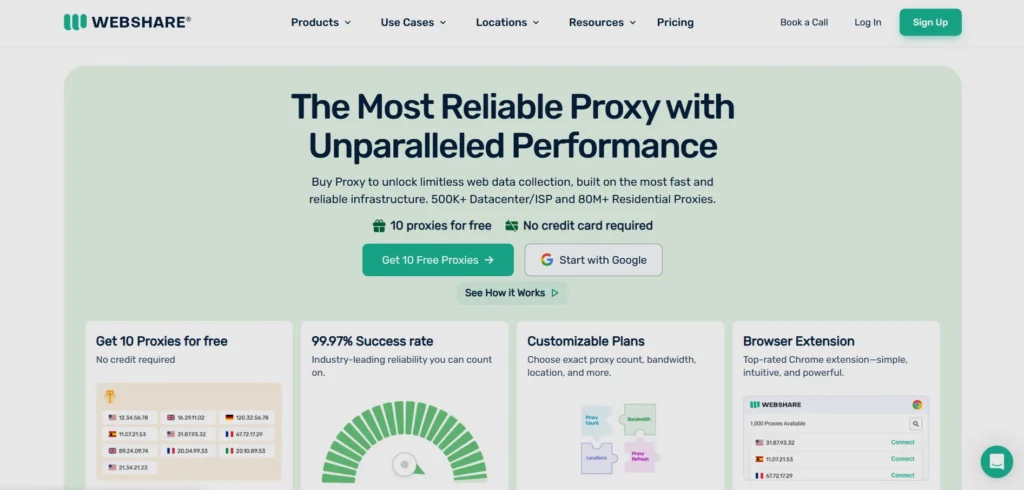
Webshare is the more practical choice when AI web scraping needs a cleaner setup and predictable infrastructure rather than a heavy enterprise stack, because its network combines 500K+ datacenter and ISP proxies with 80M+ residential proxies, HTTP and SOCKS5 endpoints, and coverage across 50+ countries. Its dedicated datacenter layer adds 100+ Gbps aggregate capacity and 99.97% uptime, so it works well for lighter browser automation, broad collection jobs, and geo-based tasks that benefit from stable routing without deep session engineering.
Best for: Lightweight AI scraping, cost-controlled collection, and simpler geo-based workloads.
Trustpilot rating: 4.1/5
4. IPRoyal
IPRoyal fits AI web scraping that mixes long-session work with localized collection because its residential proxies support sticky sessions for up to 7 days, unlimited simultaneous sessions, dual authentication, and both HTTP(S) and SOCKS5. Its residential layer also supports country, state, and city targeting across 195+ locations, which makes it useful for browser-led extraction, geo-specific monitoring, and research tasks where one identity has to stay alive longer than a standard rotating setup would allow.
Best for: Mixed enterprise workloads, long-session tasks, and geo-targeted research.
Trustpilot rating: 3.8/5
5. Decodo
Decodo is built for AI web scraping that needs concurrency and targeting depth at the same time, with 115M+ residential IPs across 195+ locations, rotating and sticky session options, country, state, city, ZIP code, and ASN targeting, plus HTTP(S) and SOCKS5 support. Its data collection stack also extends into 125M+ SOCKS5 IPs with TCP and UDP support, unlimited connections and threads, 99.86% success rate, and sub-0.6s average response time, which makes it a strong fit for session-heavy automation, app-level workflows, and high-volume extraction where routing precision cannot be an afterthought.
Best for: Session-heavy automation, app-level workflows, and high-volume collection.
Trustpilot rating: 4.2/5
6. DataImpulse
DataImpulse is useful when AI web scraping depends on granular routing parameters rather than a one-size-fits-all pool, because its stack covers residential, mobile, and datacenter proxies with country targeting by default and state, city, ZIP, and ASN targeting available as advanced filters. The service also supports pay-as-you-go usage, per-request features, and 24/7 customer support, so it fits segmented regional collection, validation tasks, and testing workflows where the output has to reflect the right local environment instead of generic access alone.
Best for: Geo-precise scraping, validation workflows, and segmented regional collection.
Trustpilot rating: 3.7/5
7. Rayobyte
Rayobyte works well for AI web scraping that needs flexible session control across more than one proxy environment, because its stack covers residential, ISP, mobile, and datacenter products, while its residential setup supports country, region/state, and city targeting with sticky sessions up to 60 minutes. Its rotating ISP layer adds US region and city targeting plus soft and hard sticky session modes, which makes it practical for monitoring, market research, and multi-step scraping runs that need a stable identity for part of the workflow without locking every request into the same routing pattern.
Best for: Balanced AI scraping workflows that combine session persistence with flexible proxy types.
Trustpilot rating: 4.1/5
What Usually Improves AI Web Scraping Stability Over Time?
Long-term stability in AI web scraping usually comes from better control, not just more volume. The most reliable setups reduce avoidable resets, keep routing consistent where needed, and match proxy behavior to the task instead of forcing one pattern everywhere. That makes day-to-day scraping more predictable and lowers the amount of wasted work.
- Cleaner Session Logic: Stable performance usually starts with deciding where a task needs continuity and where it can rotate more freely.
- Better Request Pacing: Scraping runs tend to last longer when the workflow avoids unnecessary bursts and repeated exposure to the same target.
- More Precise Routing: Stronger location matching improves output quality in regional monitoring, local search checks, and market-specific extraction.
- Less Retry Waste: A setup that fails less often in the middle of a run protects both throughput and data quality over time.
- Closer Workload Fit: Proxy behavior works better when it is aligned with the actual task, whether that task is browser automation, validation, or broad collection.
How Do AI Agents Change Web Scraping Workflows?
AI agents change web scraping because they do not stop at simple page collection. They can move through several actions in one chain, compare outputs, revisit pages, and trigger the same target multiple times within one run. That shifts the pressure from basic access toward workflow coordination, request pacing, and session discipline.
Multi-Step Runs
A single scraping task may now include discovery, extraction, checking, and follow-up actions in one sequence. That increases the chance of failure in the middle of the run, not just at the first request. In practice, proxy stability matters more when the workflow has to survive several connected steps instead of one fetch.
Repeated Validation
AI-led workflows often recheck the same page or field before saving the output. That creates a different traffic pattern from standard one-pass scraping and can expose unstable routing faster. A proxy setup that looks acceptable in short tests may break once repeated validation becomes part of the workflow.
Mixed Execution Environments
Some AI scraping tasks switch between lightweight requests and browser-based actions inside the same process. That means the proxy layer has to stay usable across different tools instead of serving one narrow type of request. The stronger setups are the ones that hold consistent behavior even when the workflow changes shape mid-run.
Conclusion
AI web scraping in 2026 works best when the proxy layer matches the workload behind it. Session-heavy browser flows, localized monitoring, and large-scale extraction all create different technical demands, so the strongest providers are the ones that stay stable under the exact conditions the scraper has to handle. A proxy that fits the task well will usually deliver cleaner data, fewer interruptions, and more consistent results over time.