
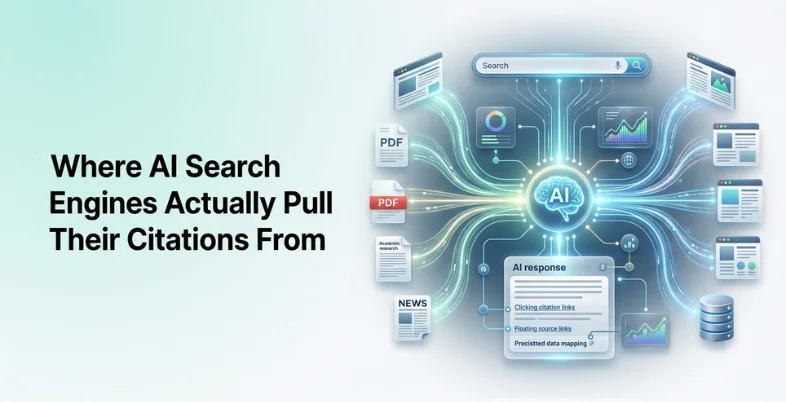
If you build links or manage off-page SEO, you already know the ground shifted. Ranking #1 on Google no longer guarantees you show up in the answer a buyer reads first. And here is the part most guides skip: the AI engines do not share a citation pool. A page ChatGPT loves can be invisible in Google’s AI Overviews. What earns a Perplexity citation gets ignored by Copilot.
So “get cited by AI” is not one target. It is five or six different targets, each fed by a different source mix. This guide maps where each major engine actually pulls from, with the current numbers, so you can point your off-page effort at the right doors instead of spraying content and hoping.
The One Stat That Reframes Everything
Only 12% of AI citations match Google’s own top-10 organic results, according to Profound’s study of 10 million AI results. Read that again. Nearly nine out of ten AI citations go to pages that are not the top Google result for that query.
That single number kills the “just rank on Google and you will be cited” assumption. AI search is its own game with its own source preferences. Here is the map, engine by engine.
ChatGPT: the biggest channel, and it runs on Reddit
ChatGPT is the dominant AI referral source by a wide margin: 62.6% of B2B AI referral traffic (Siege Media, 446K sessions, May 2026) and as high as 87.4% in enterprise datasets (Conductor, 21.9M queries). If you optimize for one engine, this is the one.
What it cites, in rough order:
- Reddit first, and heavily.
- Mainstream publications.
- Wikipedia.
- Primary sources.
The off-page implication: a credible, upvoted Reddit presence in your niche is not a nice-to-have for ChatGPT visibility. It is close to a prerequisite. Real answers in real subreddits outperform another guest post on a DA-50 blog for this specific channel.
Google AI Overviews and AI Mode: YouTube, schema, and Reddit
Google’s AI Overviews now appear on 48% to 55% of queries, so this surface is not optional. It grounds answers in:
- YouTube long-form (Google owns it, and a large share of YouTube AI citations come from Google’s own surfaces).
- Schema-structured web content (this is where clean markup earns its keep).
- Reddit, again.
If you are not producing long-form video and you are not marking up your pages with proper structured data, you are handing this channel to competitors who do.
Gemini: quietly moved into #2
Gemini overtook Perplexity as the #2 AI referral source in Q1 to Q2 2026 (Goodie AI report). It pulls 10.6% of B2B referral (Siege Media) and powers the AI Overviews above, so optimizing for Google’s corpus pays off twice.
Claude: small general share, big in B2B
Claude punches above its weight for business queries: 18.5% of B2B AI referral traffic (Siege Media, 446K sessions, May 2026), the second-largest B2B channel despite a lower general market share. It skews toward authoritative reference and research sources. If your audience is B2B, do not write Claude off because its headline market share looks small.
Perplexity: citation-first, but shrinking
Perplexity was built to cite. It rewards primary sources, recent dates, and named experts. But its referral share dropped more than 40% from its April 2025 peak (12.07% down to 7.07% by March 2026, per the Goodie AI Search Traffic Report), leaving it 3rd or 4th in most datasets. Still worth targeting because its citation-first design makes wins easier, just size the effort to its shrinking share.
Microsoft Copilot: LinkedIn and the Bing index
Copilot rides the Bing index and skews toward LinkedIn, Bing-indexed news, and B2B sources (about 4% B2B share). LinkedIn is the #1 cited domain for B2B and professional queries across engines, so a strong, active LinkedIn presence feeds Copilot and, indirectly, several other channels.
What the off-page Playbook Becomes
Put the map together and the aggregate LLM citation picture (Semrush, via BrightonSEO 2026) looks like this: Reddit 40.1%, Wikipedia 26.3%, YouTube 23.5% of LLM citations. Notice what is not on that list: the typical guest-post blog. Traditional link placements still matter for classic organic, but they are a small slice of what feeds AI answers.
So the modern off-page priority stack looks more like:
- Reddit presence that earns upvotes in your niche (feeds ChatGPT and Google).
- YouTube long-form (feeds Google AIO and Gemini).
- Structured data / schema on your own pages (feeds Google, and it is fully in your control).
- LinkedIn authority for B2B (feeds Copilot and cross-channel B2B queries).
- Wikipedia and primary-source citations where you can legitimately earn them.
- Classic backlinks, still useful, now one input among several.
This is the entity-and-citation approach behind the backlink analysis tools built for brands that want to be named inside AI answers rather than buried three clicks below them. The link is still part of it. It is just no longer the whole game.
Measure Before You Commit Budget
Do not take any of these percentages as gospel for your niche. The ordering is volatile: Reddit’s share moved about 50% inside a single quarter. Run your own check. Push one prompt set through Google AIO, ChatGPT, Copilot, and Perplexity, and log the cited domains per engine. If you surface on one but not the others for the same intent, the divergence is live and the fix is per-channel production, not more of the same asset.
Bing Webmaster Tools’ AI Performance report is the only first-party citation feed available today. Pair it with a manual prompt sweep for the engines it does not cover, and you will know exactly which door to push on.
For teams that want the full source map turned into a per-channel production plan, a dedicated AI SEO services team can build and measure it end to end. The engines each read a different corpus. Your off-page strategy should too.