


A bottleneck rarely announces itself. It hides inside a slow approval, a form that gets typed in twice, an order that waits on one person’s inbox. For a small business running lean, that friction compounds fast, because there is no spare capacity to absorb it. The reassuring part is that most operational drag traces back to a handful of fixable patterns rather than to a team that isn’t trying hard enough.
Clearing them does not require a bigger headcount or a heavy software budget. It requires seeing where work stalls and then removing the stall in the right order. What follows are five practical ways to find those choke points and open them up, so your people spend their hours on output that moves the business instead of on the busywork clogging the pipe.
5 Tips Small Businesses Can Use To Reduce Operational Bottlenecks
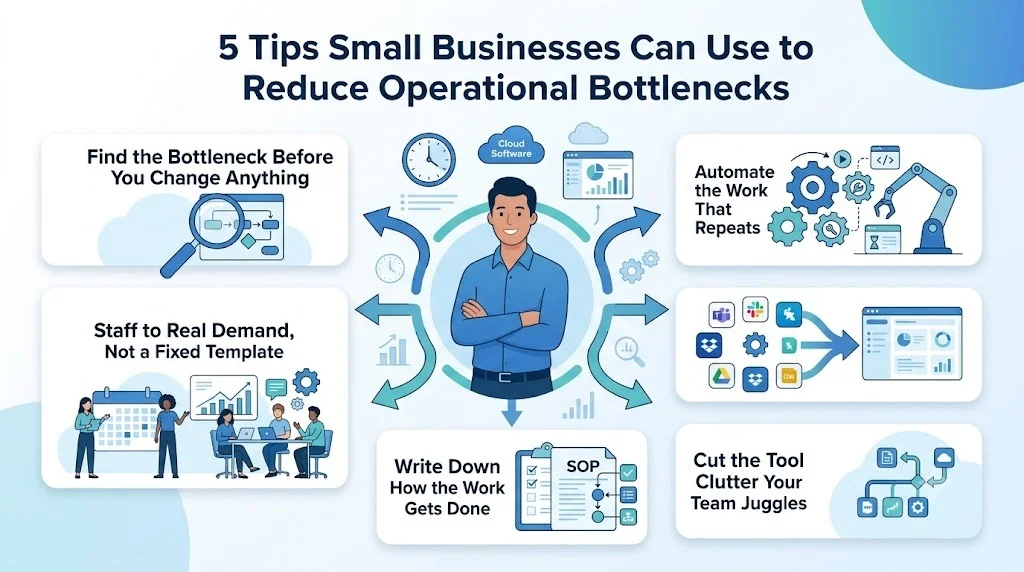
Here are the five tips that clear the most common choke points, arranged so you can start with the one causing the most drag and work down from there.
1. Find the bottleneck before you change anything
Before buying tools or reshuffling roles, map how work actually travels from request to delivery. Sketch each handoff, then time it. The step where jobs pile up and wait is your real constraint, and speeding up anything upstream only feeds that queue faster.
Asana’s research on workplace productivity found that 83% of teams believe they would work more efficiently if the right processes were in place. Most owners are surprised by where the delay actually sits, since it tends to be a quiet step rather than the loud one everyone complains about. Keep the map somewhere the whole team can see and edit, for instance inside a shared task management board where every stage and owner stays visible. Once the queue is in the open, you can decide what to cut, batch, or reassign.
2. Automate the work that repeats
Anything that follows identical steps every time- invoicing, appointment reminders, data copied between two apps- is a candidate for automation. Those tasks eat hours without adding judgment, and they are precisely where small teams bleed capacity. McKinsey’s analysis of more than 2,000 work activities found that about 60% of occupations have at least 30% of their tasks that could be automated with currently available technology.
Begin with your highest-frequency task and strip out the manual steps one by one. A contractor coordinating subcontractors, permits, and site updates might route all of it through construction management software like Ressio so those details stop scattering across a dozen spreadsheets. Even a few basic office automation tools can hand back most of a day each week that used to disappear into copy and paste.
3. Cut the tool clutter your team juggles
More apps do not translate into more finished work. Every jump from a chat window to a spreadsheet to an email thread carries a hidden reset cost.
Settle on one channel for team messaging instead of three, and push decisions through it rather than around it. Weighing your instant messaging software against what people already open every morning helps you retire duplicates instead of piling on another login. Fewer surfaces to check means fewer dropped threads and far less time hunting for the latest version of a file.
4. Write down how the work gets done
When a task lives only in one person’s head, that person becomes the bottleneck the moment they are out sick or on leave. Documented procedures remove that single point of failure. Capture how each recurring job is performed, then let anyone follow the steps. This matters most when someone new arrives: Gallup reports that only 12% of employees strongly agree their company does a great job onboarding, which is a big reason fresh hires take months to become useful.
Employee training templates paired with a short checklist for each role turn scattered know-how into something repeatable in days. Keep them where the team already works, and let AI-powered software draft a first version of a procedure from a job you perform anyway. Consistency here quietly kills rework, the most expensive delay of all.
5. Staff to real demand, not a fixed template
Not every bottleneck is a process problem. Sometimes the right number of people are simply in the wrong place at the wrong hour, so peaks back up while quiet stretches with too many hands on the clock burn payroll. Unplanned gaps sharpen the pain: the U.S. Bureau of Labor Statistics recorded a 3.2% absence rate for full-time workers in 2024, and every no-show sends a manager scrambling to cover the shift.
Build schedules around your actual demand curve and keep a little slack for the stretches you know will spike. Employee scheduling software makes coverage gaps and swap requests visible before they turn into a missed deadline or an unhappy customer. If bookings drive your day, syncing shifts with your employee scheduling tools like Homebase keeps the counter staffed to the calendar instead of to a guess.
Start With The One Constraint Costing You Most
Operational drag is seldom a single dramatic failure. It is a stack of small stalls, a manual step here, a missing checklist there, a shift left uncovered, each one quietly taxing your margins. The way out is to remove that friction in order of impact rather than pushing harder against all of it at once.
Trace the slowest handoff, automate what repeats, thin out the tools, record what only lives in someone’s memory, and match staffing to demand. Then pick the single constraint draining the most this month and clear it before touching the next. Small businesses that treat operations as something to design instead of something to endure win back the one resource they can never repurchase, which is their team’s attention for the work that actually grows the company.