

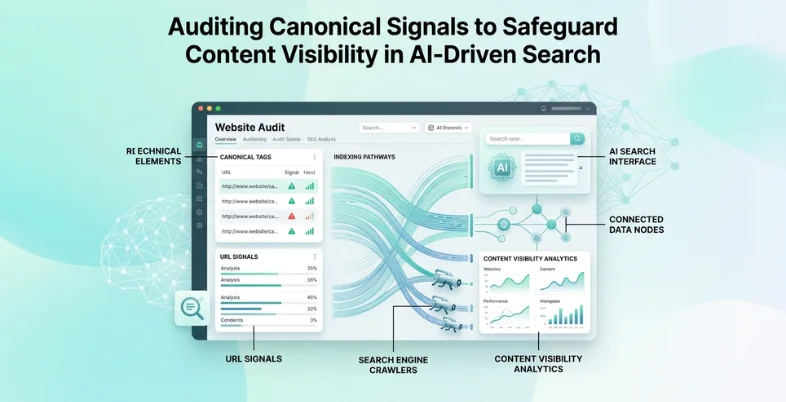
Search engines have long rewarded clarity around preferred page versions, yet the rise of generative AI features has added fresh layers of complexity. Sites that allow multiple URLs to surface the same content risk having their strongest signals scattered, especially when AI summaries pull from whichever version search engines deem representative. Regular audits help teams spot these inconsistencies before they erode visibility. Take The New York Times, which once found three near-identical article variants competing after a CMS update injected tracking parameters, diluting citations in AI Overviews until a targeted audit consolidated them.
Dynamic elements such as tracking parameters, faceted navigation, and session IDs often generate near-identical pages that compete for attention. Without explicit direction, crawlers may choose an unintended version, leaving the intended Canonical signals page with reduced internal links and external equity. Teams managing large inventories or content platforms benefit most from systematic checks that surface these conflicts quickly. Consider an e-commerce site where product filters created 12 variants of a single item page; an audit revealed that Google had selected a filtered URL as canonical, causing the main product page to lose 40% of its expected crawl frequency.
Implementing a canonical tag checker tool early in the workflow catches mismatches between the tag and actual content rendered by search engines. This step proves especially useful on JavaScript-heavy sites where server-side and client-side views diverge. Early detection prevents crawl waste and keeps consolidation signals consistent across campaigns. In one case, a SaaS company integrated such checks into their staging environment and identified a client-side redirect that overrode the canonical tag on 200 landing pages, resolving the issue before launch and preserving ranking equity.
Common Sources of Duplicate URLs on Modern Sites
Content management systems frequently append query strings for sorting, filtering, or analytics without corresponding canonical directives. Print-friendly versions and mobile-specific subdomains add further variants that search engines must reconcile. Even well-intentioned A/B testing setups can create temporary duplicates if left unaddressed after experiments conclude. A marketing team running multivariate tests on homepage hero images once left five test URLs indexed for weeks, fragmenting backlink signals until the canonicals were updated post-test.
International sites face additional hurdles when language or regional parameters create parallel structures. Without careful canonical mapping, these configurations can fragment authority across country-specific versions. Teams that map every parameter type to its canonical counterpart reduce the chance that crawlers select a secondary URL for indexing. A global retailer learned this lesson when hreflang tags pointed to regional pages but canonicals defaulted to the .com version, leading to lost visibility in non-English markets until the mappings were audited and corrected.
Why Self-Referencing Tags Remain Foundational
Even pages that appear unique benefit from explicit self-referential canonical tags. This practice removes ambiguity when Google evaluates signals and prevents accidental consolidation with similar content elsewhere on the domain. Ahrefs guide on canonical tags emphasises that absolute URLs in the tag outperform relative paths because the latter can resolve incorrectly during rendering. On a large blog network, switching to absolute self-referencing canonicals eliminated a 15% mismatch rate caused by CDN path rewrites.
Self-referencing tags also support consistent performance tracking in analytics platforms. When every page points to itself by default, teams gain clearer data on which URLs actually receive traffic and engagement. This clarity becomes valuable when reporting on content that performs well in both traditional rankings and AI-generated summaries. One analytics dashboard showed that pages with proper self-canonicals maintained 25% higher session durations in reports compared to those relying on default server behavior.
Integrating Checks Into Content Workflows
Adding canonical validation to pre-publish checklists catches issues before pages reach search engines. Automated scans during content updates or site migrations surface parameter conflicts that manual reviews often miss. Teams that embed these checks in continuous integration pipelines maintain cleaner indexes without slowing release cycles. A media company reduced duplicate canonical errors by 80% after adding a validation step that flagged query-string variants during the editorial approval process.
Periodic full-site crawls complement real-time checks by revealing patterns across thousands of URLs. Reports highlighting pages with conflicting or missing canonicals allow prioritised fixes that deliver the highest impact on crawl budget and ranking consolidation. The process also surfaces opportunities to consolidate thin variants into stronger primary pages. During a migration audit, one enterprise uncovered 3,000 low-value parameter pages that could be redirected, freeing crawl budget for core content.
Tools and Techniques for Auditing Scalable Canonical Signals
Modern auditing benefits from combining crawler-based tools with log-file analysis to detect both rendered and server-level canonical decisions. Pairing a JavaScript rendering service with Search Console data, for instance, lets teams compare intended tags against what Google actually processes. Custom scripts can also flag parameter patterns that frequently trigger alternative canonical selection, such as utm_ or sort= strings appearing on high-traffic category pages.
Training content and development teams on these tools ensures ongoing compliance. Workshops that walk through real crawl reports help stakeholders understand how a single missing canonical can cascade into reduced AI visibility. Documenting common failure modes, like session-ID leakage or faceted-navigation conflicts, creates institutional knowledge that accelerates future audits.
Key Canonical Tag Statistics (2026)
- According to the 2024 Website Almanac, 65% of mobile pages and 69% of desktop pages utilise rendered canonical tags, showing widespread but still incomplete adoption.
- The same Almanac data indicates the share of mismatched canonical tags has doubled since 2022, pointing to growing implementation complexity on dynamic sites.
- Search Engine Land analysis of 2025–2026 trends shows self-referencing canonicals remain a top recommendation for preventing unintended signal loss on both SEO and generative engine optimisation tasks.
- Industry crawls reported by multiple technical SEO platforms reveal that sites with frequent parameter-driven duplicates experience higher rates of Google-chosen alternative canonicals in Search Console reports.
- Studies of large e-commerce and publishing domains consistently find that unaddressed duplicate structures correlate with reduced visibility in AI Overviews when multiple near-identical versions exist.
Measuring Impact After Fixes
Teams track improvements through Search Console reports on duplicate without user-selected canonical issues and changes in indexed URL counts. Reductions in these metrics often coincide with steadier ranking positions and improved appearance in AI-generated answers. Monitoring over several weeks confirms whether consolidation has taken effect. A travel site observed a 30% drop in duplicate warnings and a corresponding lift in featured snippets within a month of canonical cleanup.
External link data and internal link audits provide further validation. When authority concentrates on the intended canonical, both traditional rankings and generative citations tend to stabilise. Documenting these outcomes helps justify ongoing investment in canonical hygiene across growing sites.
Search Engine Land guide to canonicalization in 2026 highlights that even small technical signals like these influence how generative systems select representative content. Maintaining clean canonical implementation therefore supports both classic SEO goals and emerging visibility channels without requiring separate optimisation tracks.