

India’s quick commerce industry is growing rapidly and is changing the way people shop for daily essentials. With instant delivery becoming the new normal in major cities, this sector has become one of the most talked-about areas in modern retail. However, unlike traditional businesses, quick commerce companies do not operate under a standard franchise model; most players, including Blinkit, run their own controlled dark-store networks.
The quick commerce market in India has grown from around $0.3–0.5 billion in 2021 to approximately $5–6 billion by 2025–2026, driven by strong urban demand and fast expansion in metro cities. At the broader level, India’s e-commerce industry is expected to reach over $300 billion by 2030, with quick commerce playing an increasingly important role in shaping consumer behavior.
Among all players, Blinkit is currently the market leader, holding roughly 45–50% share in 2026, and operating across 30+ cities with 600+ dark stores. Its strong revenue growth over the past few years reflects the rapid scaling of the business model, though it is important to note that Blinkit does not offer a traditional franchise opportunity for individual investors.
In this guide, we will explore the details of Blinkit’s business model, investment structure, and what people often refer to as the “Blinkit franchise cost” in 2026.
Overview of Blinkit
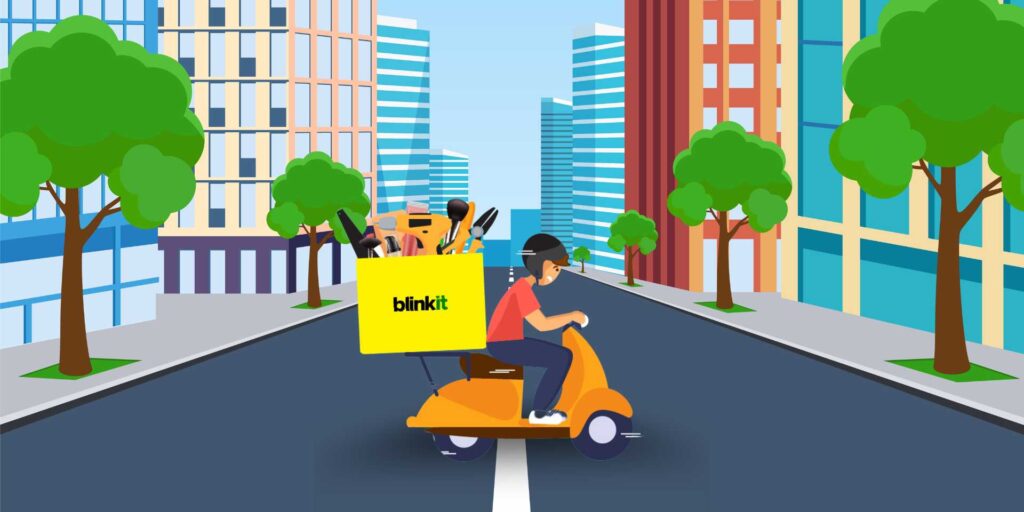
Blinkit is one of India’s leading quick commerce companies, known for delivering groceries and daily essentials in just 10–20 minutes. It started in 2013 as Grofers, founded by Albinder Dhindsa and Saurabh Kumar, and was later rebranded as Blinkit in December 2021 to focus on fast delivery services.
The company is based in Gurgaon, Haryana, and now operates in 35+ cities across India. It has around 15,000+ employees and earned approximately ₹5,206 crore (about $620 million) in FY25 revenue.
After being acquired by Zomato (now Eternal Ltd.) in June 2022 for around $570 million, Blinkit has grown rapidly and expanded its network nationwide. As of 2026, it runs more than 1,200–1,400 dark stores, making it the largest quick commerce network in India. It is also working towards reaching about 2,000 dark stores by FY26–FY27.
Today, Blinkit is the market leader in quick commerce with around 45–50% market share, ahead of competitors like Zepto and Swiggy Instamart. It continues to grow by adding hundreds of new dark stores every year.
The platform offers more than 4,000 products, including groceries, fresh food, and household essentials, helping customers get everyday items delivered quickly and conveniently.
Is Blinkit Profitable in 2026?
Yes, Blinkit has officially turned the corner into profitability as of 2026, marking a historic shift for the quick-commerce industry. The company achieved its first-ever quarterly adjusted EBITDA profit in Q3 FY26, proving that the 10-minute delivery model is financially sustainable at scale.
This massive turnaround was driven by a shift to an inventory-led model and a huge spike in high-margin non-grocery sales.
- Adjusted EBITDA Profit: Reported at ₹4 crore for Q3 FY26, a massive leap from a ₹156 crore loss in the previous quarter.
- Revenue Growth: Revenue surged by 776% YoY to reach ₹12,256 crore due to better margins on owned inventory.
- Market Dominance: Maintained a commanding ~48% market share with 243.3 million orders processed in a single quarter.
- Infrastructure Expansion: Operating 2,027 dark stores with a roadmap to hit 3,000 stores by early 2027.
Does Blinkit offer a franchise in India?
Unlike other franchises, Blinkit does not offer a traditional franchise program; rather, it operates through its special Dark Store Partnership model, FOFO (Franchise-Owned, Franchise-Operated). In simple words, you will invest in the hardware (store infrastructure), and Blinkit will provide its software (tech stack, inventory, and branding). It is a high-stakes, high-reward venture designed for those who can handle the intense operational pace of 10-minute deliveries in the booming quick-commerce sector.
Why Choose a Franchise of This Brand?
- Market Leadership: Blinkit owns 46% of the quick commerce market ollowed by Zepto (~29%) and Swiggy Instamart (~25–26%)—a strong position for franchisees., in contrast to Zepto’s 29% and Swiggy Instamart’s 26%, granting franchisees the advantage of an already established brand equity.
- Proven Business Model: The company YoY revenue growth in Q1 FY25 was 2.4×, meaning a 140–150% increase, with customers placing on average about 3–4 orders every month that generate revenues to stabilize franchise support.
- Technology Advantage: Technology is increasingly providing new avenues for operational execution: for instance, since 2022, a delivery time reduction of 22% and an inventory cost drop of 15% have been witnessed; such efficiency gains translate directly into profitability.
- Strategic Backing: Since Zomato acquired it, a strong financial backing and opportunities for cross-platform integration have arisen, thus bolstering the business for sustainability and rapid growth.
- Urban Brand Recognition: 78% urban recall ensures that franchisees undergo reduced marketing costs and speedy consumer acquisition.
- Expansion Support: Allows franchisees to grow successfully with extensive training, continuous operational support, and marketing help while minimizing risk compared to a starting point.
Blinkit Partnership Model & Types
The Blinkit Partner Program is designed for other individuals and businesses looking to collaborate with Blinkit, an instant commerce platform, across various operational aspects. It aims to expand Blinkit’s reach and efficiency by leveraging external partnerships. The Blinkit Partners Program has four different partnership models to suit various investment capacities, and market needs.
A) Partner Store (Dark Store) Owner / Franchisee
As per Franchise Model, A franchiseeoperate a mini-warehouse or dark store in our neighborhood. He will be responsible for store operations, stock management (receiving, inwarding, putaway, picking, packing, billing), and local customer satisfaction.
Requirements: Typically need a property of around 2000-3000 sq. ft. carpet area, ability to invest in inventory (approx. ₹10-20 lakhs) and setup costs (₹10-30 lakhs), and hire store staff.
A bank guarantee of ~₹30 lakhs for stocked products may also be required.
Blinkit Support: Provides technology platform, logistics and rider network, national marketing and brand promotions, assistance with store setup optimization, initial stocking, and staff training. They also assign a store manager.
Earning Potential: Monthly payouts are commission-based on monthly turnover, with an annual earning potential of up to 30% on investment, and performance-based rewards.
B) Property Rental Partner
In this partner will rent out your commercial or empty land/bare shell property to Blinkit for their dark stores.
Requirements: Properties typically need to be 2000 sq. ft. or more, with specific access, parking, and utility requirements (e.g., minimum 30 KV electricity, 2 washrooms). Must have a Property Tax Receipt (PTR) and a Commercial Electricity Meter.
C) Seller Partner
List and sell your products directly on the Blinkit platform, leveraging their instant delivery network.
Requirements: Need business details (GSTIN, PAN, bank account), high-quality product images and descriptions, and relevant licenses (e.g., FSSAI for food items).
Blinkit Support: Offers a user-friendly seller dashboard for managing products, orders, and inventory, verification and onboarding training, promotional campaigns, and data insights.
Charges: Blinkit charges a platform commission (typically 10%-20% depending on category), plus GST on commission and TCS.
D) Delivery Partner
Role: Independently pick up orders from Blinkit dark stores or partner merchants and deliver them to customers using your own two-wheeler.
Requirements: Must be 18 years or older, own a two-wheeler, have an Android phone with internet, a valid driving license, RC, insurance, PAN card, address proof, and an active bank account.
Benefits: Flexible work hours (choose your own slots), weekly payouts based on a ‘per packet’ model with additional incentives for weight and distance, joining and referral bonuses, and insurance coverage. Earn up to ₹50,000 per month with incentives.
Blinkit Franchise Cost in India: Detailed Cost Breakdown
| Category | Dark Store Model | Mini Outlet Model |
| Franchise Fee | ₹4–5 Lakhs (Tier 1) ₹3–4 Lakhs (Tier 2) ₹2–3 Lakhs (Tier 3) | ₹2–3 Lakhs (Tier 3–2 Cities) |
| Infrastructure Setup | ₹7–12 Lakhs (2,000–3,000 sq ft) | ₹3–5 Lakhs (200–500 sq ft) |
| Initial Inventory | ₹5–7 Lakhs (4,000+ SKUs) | ₹2–3 Lakhs (High-demand SKUs) |
| Rental Deposit | ₹3–10 Lakhs | ₹0.5–2 Lakhs |
| Licensing & Compliance | ₹0.5–1 Lakh | ₹0.5–1 Lakh |
| Staff Training | ₹0.5–1 Lakh | ₹0.5–1 Lakh |
| Working Capital | ₹3–5 Lakhs | ₹1–2 Lakhs |
| Total Initial Investment | ₹21–39 Lakhs | ₹8.5–15 Lakhs |
Franchise Fee
- Tier 1 Cities (Delhi, Mumbai, Bangalore): 4-5 lakhs franchise fee because of top end market location, good customer concentration, high revenue potential with developed infrastructure and wealthy customer segments.
- Tier 2 Cities (Pune, Hyderabad, Chennai): 3-4 lakhs franchise fee and this is due to the emerging market position and the increasing consumer interest towards digital commerce sites with great potential of growth.
- Tier 3 (Emerging Markets) Cities: 2-3 lakhs franchise fee to give an entry point to smaller cities entrepreneurs to benefit from quick commerce growth outside the metropolis.
- Franchise Benefits: The one-time fee provides the franchisee with the entire rights such as exclusive territory for operation and entry into the proprietary technology systems of Blinkit, operational procedure, brand license and the continued corporate support.
Initial Setup & Inventory
- Dark Store Infrastructure: 7-12 lakhs investment in 2,000-3,000 sq ft fulfillment centers including special storage systems, temperature control apparatus, sorting machines, packaging area and loading docks.
- Mini Outlet Infrastructure: 3-5 lakhs investment in 200-500 sq ft stores with emphasis on customer friendly areas, simple storage facilities, point of sale systems in the neighborhoods.
- Dark Store Inventory: 5-7 lakhs initial stock investment on 4000 + SKUs covering groceries, fresh items, personal care products, and household essentials to have the entire product range.
- Mini Outlet Inventory: 2-3 lakhs design portfolio investment with emphasis on high demand fast moving products with emphasis on quick turnover and local tastes.
- Other Set up costs: Security deposits (1-2 Dark Store Lakhs, 0.5-1 Mini Outlet Lakh), legal compliance and licensing ( 0.5-1 Lakh), and the staff training programs ( 0.5-1 Lakh).
Total Initial Capex
- Dark Store Model Total: 21-39 lakhs of the total Blinkit Franchise Cost investment inclusive of franchise fee (3-5 lakhs), infrastructure development (7-12 lakhs), inventory (5-7 lakhs), rental deposits (3-10 lakhs), and working capital reserves (3-5 lakhs).
- Mini Outlet Model: Investment of 8.5-15 lakhs available that includes franchise fee (2-3 lakhs), infrastructure setup (3-5 lakhs), initial inventory (2-3 lakhs), rental deposits (0.5-2 lakhs) and working capital (1-2 lakhs).
- Investment Flexibility: Ranges fit the different market conditions, location premiums and individual franchise requirements and provide sufficient capitalization to operate successfully across the many tiers of cities.
Operating Expenses (Opex): Royalty/Commission
| Expense Type | Range |
| Royalty Fee | 5–10% of gross monthly revenue |
| Technology Fee | 2–3% of gross monthly revenue |
| Marketing Contribution | 1–2% of gross monthly revenue |
| Employee Wages | ₹2,00,000 – ₹5,00,000 |
| Utilities & Operations | ₹15,000 – ₹30,000 |
| Inventory Replenishment | ~60–70% of monthly revenue |
| Facility Maintenance | ₹10,000 – ₹20,000 |
| Insurance & Compliance | ₹5,000 – ₹10,000 |
- Monthly Royalty Fee: 5-10 percent of gross revenue that guarantees corporate support, brand development, operational guidance and access to proven business systems and methodologies.
- Technology Fee: 2-3% monthly revenue that offers access to innovative inventorying systems, order-processing platforms, customer relationships management tools and real-time analytics.
- Marketing Contribution: 1-2 percent of monthly revenue to fund national advertising campaigns, online marketing efforts, brand building efforts, and customer acquisition efforts.
Ongoing Costs
- Employee wages: 2,00,000-5,00,000 per month based on the size of teams, local wages rates and needs of operation to maintain the quality and efficiency standards of services.
- Utilities & Operations: 15,000-30,000 per month including electricity, water, telecommunications, and internet connectivity, and other essential services required to run business in a smooth manner.
- Inventory Replenishment: 60-70 percent of revenue is largest recurring cost to maintain steady product stock keeping, freshness levels and ability to keep up with customer demand patterns.
- Facility Maintenance: 10,000-20,000 per month to service equipment, keep facilities in a good condition, and clean services and ensuring the operational standards per the Blinkit specifications.
- Insurance & Compliance: 5000-10000 rupees per month on business insurance, regulatory compliance, safety certifications and legal requisite of handling and retailing of foods.
Blinkit Partnership Cost by Location
The cost of setting up a Blinkit dark store varies significantly based on real estate demand and the expected order volume of the specific territory. Here is a detailed breakdown of what you can expect to invest in different Indian tiers.
| Investment Component | Delhi NCR (Metros) | Tier 2 Cities |
| Security Deposit | ₹2 Lakh – ₹5 Lakh | ₹1 Lakh – ₹2 Lakh |
| Infrastructure & Interiors | ₹15 Lakh – ₹40 Lakh | ₹5 Lakh – ₹12 Lakh |
| Initial Inventory/Assets | ₹10 Lakh – ₹20 Lakh | ₹3 Lakh – ₹8 Lakh |
| Working Capital (3 Months) | ₹10 Lakh – ₹15 Lakh | ₹4 Lakh – ₹7 Lakh |
| Total Estimated Cost | ₹37 Lakh – ₹80 Lakh+ | ₹13 Lakh – ₹29 Lakh |
Profitability & ROI Expectations
Revenue Potential
The Blinkit Franchise Cost investment provides massive profit potential as supported by the growing quick commerce industry in India. The Dark Store franchises make remarkable monthly revenues of 18-25 lakhs whereas the Mini Outlets make 7-12 lakhs monthly. These numbers indicate the high consumer interest in 10-minute delivery services as customers order the product on average 3.8 times per month.
Gross margin is between 18-22 percent of total revenue which implies that profitability margins are healthy which translates to 3.2-5.5 lakh of monthly gross profit of Dark Stores and 1.3-2.6 lakhs of monthly gross profit of Mini Outlets.
Break-even Timeline
The realistic break-even periods of the franchise partners can be based on the Dark Store operations of 18-24 months and Mini Outlets of 15-20 months. These schedules depend on the key success factors such as the quality of location, local market competition, population density in the delivery areas, and the level of efficiency of operations.
Ideal sites in affluent communities are normally able to break-even 25-30 percent quicker than an average place, and superb operational control may be able to hasten revenue by 15-20 percent.
ROI
The 3-year ROI projected shows attractive returns of 45-60 percent for Dark Store models and 55-70 percent in case of Mini Outlets. The monthly profitability of Dark Stores is generally 1.4-2.5 lakh rupees whereas Mini outlets are 0.6-1.2 lakh rupees, which is already a healthy 8-10 percent net margin on total revenue and that is why this investment will be very lucrative in the present market scenario.
Key Requirements & Setup
- Financial Qualifications: The candidates should have net worth of 40 lakhs in case of Dark Stores or 20 lakhs in case of Mini Outlets, liquid capital of 15-20 lakhs and CIBIL score of 700 to be eligible to get the loan.
- Space Requirement: Dark Stores need 2,000-3,000 sq ft of commercial space in high-density locations, whereas the Mini Outlets need 200-500 sq ft with frontage of 10-15 feet and sufficient parking space of the delivery trucks.
- Professional Experience: Candidates must have a 2-3 years of business management experience, ideally in retail/e-commerce industries, have a good leadership ability to support 5-15 employees, and operational experience.
- Legal Compliance: Should be able to set the right business structure (Proprietorship/Partnership/LLP/Pvt Ltd), GST registration, FSSAI food safety license and Shop & Establishment License with local municipal authorities.
- Location Criteria: First-rate location in resident or business high-traffic areas where the demographics are excellent, there is a high visibility, easy accessibility and location near the target customer base that leads to the right performance.
- Technology Readiness: Ability to connect with the advanced technology systems, digital payment platforms, inventory management software and order processing systems of Blinkit to operate smoothly and track them in real time.
How to Apply for Blinkit Franchise in 2026
- Contact Blinkit Franchise Department: You can reach out to the Blinkit partnership model.
- Consider Franchise Requirements: Take time to review all the requirements of investments such as infrastructure, inventory, and operating cost and make sure your business space matches the Blinkit specifications of 2000-3000 sq ft of fulfillment centers.
- Application Process: Fill in all required fields in the franchise application package and attach your identity, financial and property documents where applicable to the franchise setup and send them to Blinkit.
- Sign the Franchise Agreement: Sign the formal franchise agreement that defines what has to be done by the business, how to operate and the revenue sharing aspects of all the franchise businesses.
- Find the Fulfillment Center: Find a place, where the target clients live, develop the necessary infrastructure at the storage facilities, and make sure that the distribution channels satisfy all the safety demands.
- Join the Training and Support Programs: Undergo all the Blinkit training programs, including inventory management, order management, customer support services and link your business with the Blinkit technology infrastructure.
- Introduce and Market the Franchise: Carry out the formal launch of the franchise activities with the assistance of the Blinkit management and apply the available advertising collaterals and marketing strategies to bring in the initial customers.
- Direct Daily Tasks: Oversee daily logistic activities such as inventory management tasks, attend to all customer queries and track key performance indicators to ensure that Blinkit delivers business performance to its operational standards.
Contact Details:
- [email protected]
- Link: https://blinkit.com/rentyourproperty
- Official Link: https://blinkit.com/franchise
- Official Website: https://blinkit.com/
Who Should Consider This?
- Experienced Entrepreneurs: Business owners with 2-3 years of management experience, especially in retail or e-commerce domains, who are familiar with operational intricacies and customer service demands.
- High-Net-Worth Individuals: Investors with demonstrated financial capacity (₹20-40 lakhs net worth) looking for diversified streams of income through established business models, as opposed to speculative ones.
- Retail Industry Veterans: Professionals having experience in grocery retail, supply chain, or FMCG distribution who can capitalize on their existing industry knowledge or relationships.
- Tech-Savvy Operators: Individuals comfortable with tech skills for operating any quick-commerce business, including digital platforms, inventory management systems, and data-driven decision making.
- Location Advantage Holders: Real estate owners or property holders with access to premium commercial layout and construction in areas of high-density residential or commercial zone suitable for quick-commerce.
- Growth-Oriented Investors: Entrepreneurs looking for scalable businesses in growing markets, willing to invest time and resources in building long-term wealth through franchise expansion.
Tips to Enhance Success
- Strategic Location Choice: High-visibility locations in densely populated areas with a strong demographic, and where delivery vehicles can easily gain access, are really the best venues that will ensure the customers pick up orders with high frequency.
- Inventory Optimization: The data-driven aspect of inventory management needs spotlighting on fast-moving SKUs according to seasonal demands and local preferences, thereby reducing wastage and enhancing stock availability.
- Staff Training Excellence: Heavy investment is needed in staff training programs to develop skills in customer service, technology systems, and operational procedures in order to keep service quality and efficiency intact.
- Technology Integration: While maximizing the techno-platforms of Blinkit for the processes of order management, inventory tracking, and customer engagement, complement all that with some local digital marketing thrust.
- Community Engagement: Upon the foundation of personalized service, initiate relationships with the local customers through community events and loyalty programs, encouraging retention and referrals.
- Operational Efficiency: Regular measurement of KPIs, optimizing delivery routes, maintaining quality standards, and costs controlling activities would continue being measures to maximize profitability and operational excellence.
Risks of Blinkit Partnership
While the growth numbers look fantastic, entering a partnership involves navigating several high-pressure operational and financial hurdles. These risks are as follows and should be weighed carefully before investing:
- High Initial Investment: The startup cost remains quite steep due to the expensive setup process and security deposit.
- Intense Operation: A highly intensive environment that is running 24/7, and a 5-minute delay can affect store ratings negatively.
- Heavy Platform Dependence: Your success strongly depends on Blinkit’s algorithms and its ability to attract customers to your store.
- Labor Intensive: Constant recruitment and training of new employees are needed due to high turnover among warehouse/delivery workers.
- Thin Margins: The net margin per order may be tight despite high revenues due to rising electricity/rent/package prices.
Blinkit vs Zepto vs Swiggy Instamart
The quick-commerce race in India is a three-way battle for the “top of mind” consumer spot, with each player utilizing a slightly different strategy to win the neighborhood.
| Feature | Blinkit (Zomato) | Zepto | Swiggy Instamart |
| Market Share | ~48% (Leader) | ~20-25% | ~20-22% |
| Core Strength | High-value items (Electronics/Beauty) | Pure speed (Consistent <10 mins) | Massive existing Food delivery user base |
| Inventory Model | Heavily Inventory-led | Dark Store Optimized | Hybrid (Marketplace + Dark Store) |
| Profitability Status | EBITDA Profitable (2026) | Rapidly narrowing losses | Leveraging Swiggy ecosystem synergies |
| Store Network | 2,000+ Stores | ~500+ (Aggressively expanding) | Deep integration in 30+ cities |
Conclusion
Blinkit Franchise Cost in India is an attractive investment option in the fast growing quick commerce India market. Franchisees can receive a proven business system with the support of market leadership and a robust brand identity with the total investments of between 8.5-39 lakhs depending on the selected model. The remarkable spurt in the development of quick commerce, paired with Blinkit securing 40 percent of the market share and the support of Zomato, will make franchises successful.
The financial viability of this opportunity is evidenced by the three-year projected ROI of 45-70%, and break-even schedule of 15-24 months. Strategic location, proper capitalization and operational excellence are major success factors that make it the most suitable business venture to experienced entrepreneurs willing to take advantage of the digital commerce revolution in India.
Also Read:
FAQs
How much do I have to pay as Blinkit Franchise Cost in India?
The lowest amount of investment is 8.5 lakhs of a model called Mini Outlet, and the Dark Store franchise needs 21-39 lakhs of investment depending on location and requirements of setup.
Payback period of the Blinkit Franchise?
Break-even is usually in 15-20 months in case of Mini Outlets and 18-24 months in case of Dark Stores based on the performance of the location and efficiency of operation.
What are some of the recurring charges involved in the Blinkit Franchise Cost?
The royalties of 5-10 percent, 2-3 percent technology fee as well as 1-2 percent marketing contribution all make up a total of 8-15 percent of gross revenue charged on a monthly basis.
Does Blinkit finance franchise costs?
Blinkit will tie up with few financial institutions that will provide specially crafted financing and advice to the franchisees on availing business loans.
What is the ROI of investment in Blinkit Franchise Cost?
The 3-year ROI is expected to be 45-60 percent in case of Dark Stores and 55-70 percent in case of Mini Outlets with monthly net profit of 8-10 percent of revenue.