

According to MarketsandMarkets’ 2025 research, the global healthcare BPO market was valued at USD 417.68 billion in 2025 and is projected to reach USD 694.35 billion by 2030, growing at a CAGR of 10.7%. For hospital systems, health plans, and telehealth platforms scaling their operations, that growth creates both opportunity and a significant vendor selection challenge.
The administrative complexity of modern healthcare—HIPAA compliance, multilingual patient communication, revenue cycle management, prior authorization backlogs, and virtual care enablement BPO support—demands outsourcing partners with genuine regulatory depth, not just cost arbitrage. The wrong partner exposes you to breach risk, billing errors, and patient experience failures that erode trust faster than any efficiency gain can recover.
This guide examines five leading healthcare BPO companies—covering what each delivers, who they serve best, and how their pricing models work—so you can make an informed decision for 2026 and beyond.
What Healthcare BPO Covers
Healthcare business process outsourcing (BPO) refers to contracting specialized third-party providers to manage non-core administrative, clinical support, and patient-facing operations. While many industries outsource for cost reduction alone, healthcare outsourcing carries a stricter mandate: every process must operate inside a compliance framework that protects protected health information (PHI) under HIPAA, and increasingly, GDPR for global operations.
Core components of healthcare BPO typically include:
- Revenue cycle management (RCM): End-to-end claims processing, billing, denial management, and collections to optimize cash flow
- Patient access and scheduling: Appointment booking, pre-registration, eligibility verification, and referral management
- Prior authorization support: Insurance verification, PA submission, follow-up, and appeal workflows
- Clinical documentation and coding: Medical coding (ICD-10, CPT), clinical documentation improvement, and audit support
- Back-office operations: Data entry, claims adjudication support, and medical records management
- Virtual care and telehealth support: Patient triage, remote patient monitoring (RPM) support, and post-visit follow-up
- Omnichannel patient communication: Inbound and outbound phone, email, chat, and SMS across multiple languages
A capable healthcare BPO partner should bring three non-negotiable capabilities to every engagement. First, documented compliance infrastructure—SOC 2 Type II, HIPAA, and relevant state privacy certifications, not just verbal assurances. Second, clinical-context agent training: staff who understand healthcare workflows and communicate with appropriate patient empathy. Third, real-time quality monitoring with transparent reporting that gives you visibility into every interaction.
Companies increasingly rely on healthcare outsourcing to address staffing shortages, reduce operating costs by 20–40%, and improve patient satisfaction scores. Telehealth expansion has added a fourth driver: the need for scalable virtual care enablement support that flexes with demand without compromising care quality or compliance.
Top 5 Healthcare BPO Companies for 2026: Comparison
| Company | Services | Global presence | Employees | Year est. |
|---|---|---|---|---|
| Helpware CX | Patient support, RCM back-office, HIPAA-compliant CX, prior auth support, multilingual omnichannel | USA, Philippines, Ukraine, Mexico, Georgia, Poland, Germany, Albania (19 locations total) | 4,000 | 2015 |
| Teleperformance | Patient care, claims processing, healthcare CX, telehealth support, AI-enabled BPO | France, USA, Philippines, India, Mexico, Colombia, UK, Brazil, Greece, Germany (95 countries total) | 500,000 | 1978 |
| Cognizant | RCM, payer/provider BPO, clinical coding, eligibility, denial management, TriZetto platform | USA, India, UK, Philippines, Canada, Brazil, Mexico, Netherlands, Hungary, Australia (40+ countries) | 357,884 | 1994 |
| EXL Service | Healthcare analytics BPO, claims management, utilization management, population health analytics | USA, India, Philippines, UK, Colombia, Australia, South Africa, Mexico, Romania, Ireland (6 continents) | 61,000 | 1999 |
| Omega Healthcare | RCM, prior authorization, clinical coding, patient access, care coordination | USA, India, Colombia, Philippines (14 delivery centers) | 30,000 | 2003 |
List of Top 5 Healthcare BPO Companies: Overview
1. Helpware CX
Founded in 2015 and headquartered in Lexington, Kentucky, Helpware CX operates 19 locations across 12 countries, including the USA, Philippines, Mexico, Ukraine, Georgia, Poland, Germany, and Albania. In healthcare, the company delivers HIPAA-compliant BPO services spanning patient support, insurance verification, prior authorization inquiries, appointment scheduling, back-office claims operations, and multilingual patient communication in 45 languages.
Clients including Headspace, HealthComp, NexHealth, and CompIQ have structured Helpware CX as an extension of their own care teams. The company’s 2.8% monthly attrition rate—well below the 6–8% industry average—means the agents trained on your HIPAA workflows and patient protocols stay consistent and accountable.
Key details:
- Services: HIPAA-compliant patient support, insurance verification, prior authorization, RCM back-office, omnichannel patient communication, clinical data entry
- Best for: Telehealth platforms, health plans, and multi-site provider groups ($50M+ revenue) that need HIPAA-compliant multilingual support with compliance depth and operational customization
- Locations: USA, Philippines, Ukraine, Mexico, Georgia, Poland, Germany, Albania, Puerto Rico (19 locations total)
2. Teleperformance
Founded in 1978 and headquartered in Paris, France, Teleperformance is one of the largest BPO providers globally, with nearly 500,000 employees across 95 countries following its integration of Majorel in early 2025. The company serves healthcare and life sciences clients with patient care services, healthcare CX, telehealth BPO, claims processing, and AI-enabled contact center operations—delivering support across 300 languages.
Its TP Sentinel compliance program and healthcare-specific certifications create a robust compliance baseline for regulated healthcare environments. The scale advantage is Teleperformance’s clearest differentiator: enterprise healthcare organizations that need to deploy thousands of agents quickly across global markets have few alternatives at this size.
Key details:
- Services: Patient care, claims processing, healthcare CX, telehealth support, AI-enabled BPO operations, content moderation
- Best for: Large enterprise health systems and payers (500M+ revenue) with substantial global patient interaction volumes who prioritize vendor stability and geographic coverage
- Locations: France, USA, Philippines, India, Mexico, Colombia, UK, Brazil, Greece, Germany (95 countries total)
3. Cognizant

Founded in 1994 and headquartered in Teaneck, New Jersey, Cognizant operates across 40+ countries with 357,884 employees and a dedicated healthcare and life sciences practice built on the TriZetto platform it acquired in 2014. The company processes 4.4 billion healthcare transactions annually, covering RCM, payer operations, clinical coding, eligibility verification, denial management, and utilization management.
In August 2025, Cognizant launched the TriZetto AI Gateway, embedding generative AI directly into its healthcare software stack. For a MetroHealth partnership, Cognizant achieved a 30% reduction in denial rates and added $13 million in revenue—demonstrating the depth of its RCM technology integration alongside managed services delivery.
Key details:
- Services: Revenue cycle management, payer/provider BPO, clinical coding, eligibility verification, denial management, TriZetto healthcare technology platform
- Best for: Large enterprise healthcare organizations that need deep RCM technology integration combined with managed services at scale
- Locations: USA, India, UK, Philippines, Canada, Brazil, Mexico, Netherlands, Hungary, Australia (40+ countries)
4. EXL Service

Founded in 1999 and headquartered in New York, EXL operates as a global data and AI company with 61,000 employees across six continents. Its healthcare and life sciences segment covers claims management, payment integrity analytics, utilization management, population health analytics, and care management.
In 2025, EXL launched Service-as-Agentic-Solutions—an AI-native operational model applying agentic automation to clinical and administrative workflows. Recognized as a Gartner Magic Quadrant Leader for Finance and Accounting BPO in 2025, EXL brings Lean Six Sigma process methodology to its healthcare engagements, differentiating it from pure-play BPO operators by baking process optimization into the operating model rather than treating it as an add-on.
Key details:
- Services: Healthcare analytics BPO, claims management, utilization management, population health analytics, payment integrity, care management
- Best for: Enterprise health plans and payers seeking a data-and-analytics-led BPO partner with strong process methodology and AI-native capabilities
- Locations: USA, India, Philippines, UK, Colombia, Australia, South Africa, Mexico, Romania, Ireland (6 continents)
5. Omega Healthcare
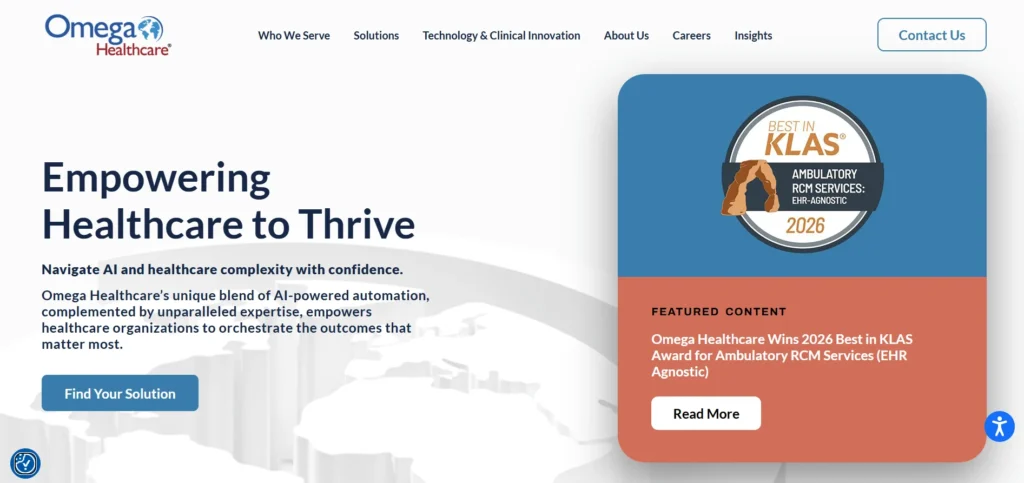
Founded in 2003 and headquartered in Boca Raton, Florida, Omega Healthcare is a dedicated healthcare BPO provider with 30,000 employees across 14 delivery centers in the USA, India, Colombia, and the Philippines. Its Omega Digital Platform integrates robotic process automation (RPA), machine learning, and natural language processing (NLP) to automate billing, coding, and documentation workflows at scale.
In 2026, Omega Healthcare won the Best in KLAS award for Ambulatory RCM Services with a 97.8 out of 100 overall performance score. Named a Leader in the IDC MarketScape for US Revenue Cycle Management Service Solutions in 2025–2026, Omega Healthcare’s specialized depth in provider-focused RCM makes it a strong fit for organizations whose primary outsourcing need is revenue cycle optimization.
Key details:
- Services: Revenue cycle management, prior authorization, clinical coding, patient access, care coordination, pharmaceutical market access
- Best for: Provider organizations, health systems, and payers seeking a specialized healthcare-only RCM and operations partner with proven KLAS performance
- Locations: USA, India, Colombia, Philippines (14 delivery centers)
Pricing Models for Healthcare BPO
Healthcare BPO pricing varies more than most service categories because the compliance infrastructure, agent specialization, and language requirements the industry demands do not fit generic cost models. Here is how providers typically structure their pricing.
Common Pricing Models Include:
- Per-hour managed services: The standard model for patient support, scheduling, and back-office operations. Rates range from $8 per hour for nearshore or offshore delivery to $35 or more for onshore specialized roles. Helpware CX prices at $8–$15 per hour depending on service complexity, delivery location, and engagement model.
- Per-claim or per-transaction: Common in RCM-focused engagements, where providers charge per claim processed, denial worked, or record coded. This model aligns costs with volume but requires quality SLAs to prevent incentive misalignment.
- Monthly retainer (outcome-based): An emerging model where the BPO partner takes accountability for specific outcomes—first-pass resolution rates, denial rate targets, CSAT scores—with pricing tied to performance. Best suited for mature partnerships with defined baseline metrics.
- Hybrid: Many healthcare BPO contracts combine a base managed services rate with performance incentives or per-transaction overlays for overflow volumes.
Several factors drive pricing beyond the base model. HIPAA compliance infrastructure adds real cost—SOC 2 audits, security architecture, and compliance officer access are overhead items that distinguish specialized healthcare BPO from commodity outsourcing. Multilingual capability with native speakers adds a premium over generalist staffing. Healthcare-specific training (coding certification, clinical terminology, payer-specific workflows) increases onboarding cost and agent rate. Helpware CX’s $8–$15 per hour range reflects nearshore and offshore delivery with full compliance infrastructure, native-speaker language capability, and healthcare-specific training built in.
FAQs
What Is Healthcare BPO?
Healthcare business process outsourcing (BPO) refers to delegating administrative, operational, and patient-facing functions to specialized third-party providers. This includes revenue cycle management, patient access, prior authorization, clinical coding, back-office operations, and patient support. Unlike general BPO, healthcare outsourcing requires certified HIPAA compliance infrastructure to protect patient health information (PHI) across every process and communication channel.
What Compliance Certifications Should a Healthcare BPO Have?
At minimum, look for SOC 2 Type II certification, a signed HIPAA Business Associate Agreement (BAA), and documented security controls covering access management, encryption, breach notification timelines, and data residency requirements. ISO 27001 adds an additional information security rigor layer. Request the actual audit reports, not just badge references on a vendor’s website. A strong answer names specific controls and compliance officers—not just marketing language about “robust compliance programs.”
How Is Healthcare BPO Different From General BPO?
Healthcare BPO operates under stricter regulatory requirements than general BPO because it handles protected health information (PHI). Compliance infrastructure is mandatory rather than optional, agents require clinical-context training, data handling protocols must meet HIPAA standards, and quality monitoring must track compliance risk—not just productivity. The cost premium of healthcare-specialized BPO reflects this operational complexity and the risk management overhead it carries.
What Is Virtual Care Enablement BPO Support?
Virtual care enablement BPO support covers the operational layer that makes telehealth platforms function at scale. This includes patient scheduling for virtual visits, insurance verification, prior authorization inquiries, post-visit follow-up communication, remote patient monitoring (RPM) support, and multilingual patient outreach. As telehealth adoption expands, this specialized BPO function has become a distinct service category with its own compliance requirements and communication protocols.
How Do I Choose The Right Healthcare BPO Partner?
Focus on three areas before evaluating rate cards. First, compliance depth—request the SOC 2 Type II audit report and HIPAA BAA template, and confirm the name of the compliance officer you will have direct access to if an incident occurs. Second, attrition rate—high staff turnover creates PHI risk and quality inconsistency; the industry average is 6–8% monthly, and vendors below 3% are outliers. Third, healthcare-specific performance metrics—ask to see QA scorecards with call-level quality scoring from a current client engagement. Vendors that can produce those documents quickly are the ones actually running those programs.
What Does Healthcare BPO Cost?
Pricing ranges from $8–$15 per hour for nearshore and offshore delivery with full HIPAA compliance infrastructure to $25–$35 or more for onshore specialized roles. RCM-focused engagements often use per-claim pricing. Cost drivers beyond geography include compliance infrastructure, native-speaker multilingual capability, clinical specialization level, and engagement model (per-hour, per-claim, or outcome-based). Outcome-based pricing is growing as a preferred model for healthcare organizations that need vendor accountability tied to measurable financial and clinical outcomes.