

Keeping regulators and customers happy once meant juggling separate tools: one spreadsheet for your Record of Processing Activities (ROPA) and another dashboard for SOC 2 evidence. Copy-paste ruled the day.
Firms spend about $5.47 million a year on compliance overhead, and the bill spikes whenever a new framework lands. Since 2018, authorities have issued €5.65 billion in GDPR fines, often for missing documentation or weak controls.
A new wave of Governance, Risk & Compliance (GRC) platforms, especially advanced GRC software for TPRM, fixes that by merging privacy workflows and security audits. This guide compares six of them and shows how they cut spreadsheets, speed audits, and reduce third-party risk more effectively.
Top GRC Platforms: Who Makes the Short List?
Below, we dive into the six vendors that merge privacy and security in one console. We start with the platform that sets the pace, then work down the list.
1. Vanta: fast-track compliance with built-in privacy
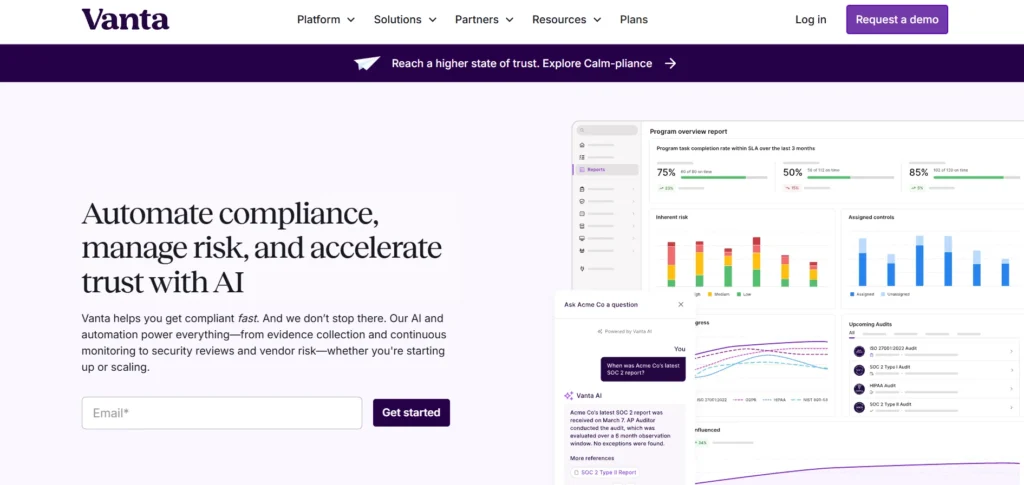
Vanta is a unified trust management platform that brings GDPR privacy workflows, SOC 2 automation, vendor risk management, and trust reporting into a single system, similar to what you see across leading GRC platforms. For teams trying to stop duplicating work across legal, security, and procurement, the value is simple: you document a control once, collect evidence continuously, and reuse it across frameworks.
On the GDPR side, Vanta’s GRC platform gives you an interactive data inventory where you can track purpose, lawful basis, retention schedules, and linked vendors. That inventory can be exported as an Article 30–ready ROPA, so your “source of truth” is not a spreadsheet that goes stale. Privacy teams can also run DPIAs in the platform, assign owners, and track remediation alongside security work. Support for privacy is still expanding, but the core workflow is designed to keep documentation current and connected to real controls.
Where Vanta is especially strong is security audit readiness. The platform supports dozens of frameworks and runs automated tests hourly, pulling evidence from your existing stack via hundreds of integrations. That means your SOC 2 (and overlapping GDPR Article 32 requirements) are continuously checked, not re-proven during a quarterly scramble. When something fails, Vanta can guide remediation with AI-powered suggestions, including code snippets, and it supports auditor collaboration through a dedicated auditor portal plus an Auditor API.
Vendor risk is not an afterthought. Vanta’s VRM capabilities include shadow IT discovery via IdP integrations, vendor intake with customizable rules, and continuous vendor monitoring with breach alerts. For the part every team dreads—questionnaires—Vanta includes QAuto to automate responses, with strong answer acceptance rates reported by customers. It also integrates with procurement tooling like Zip and Coupa and supports vendor-to-vendor trust sharing via Vanta Exchange. Teams often report meaningful cuts in security review time and evidence gathering effort after rolling out these workflows.
For go-to-market, Vanta’s Trust Center helps you turn compliance work into a customer-ready asset. You can publish SOC 2 reports and security posture in a controlled portal, handle NDA collection, and enable self-serve responses with an AI-powered chatbot. Thousands of public Trust Centers have been deployed on Vanta, and CRM integration supports revenue attribution so you can tie trust work to deal motion.
Implementation is typically fast for the scope covered here. Most companies reach audit-ready in a handful of weeks, with free implementation services available, plus professional migration support for teams switching from another platform.
Vanta is ideal for:
- Mid-market and enterprise companies that need one system for GDPR documentation, SOC 2 readiness, and vendor reviews
- Security and compliance teams that want continuous assurance (hourly testing) rather than periodic evidence drives
- Organizations that need to prove trust externally through a customer-facing Trust Center and faster questionnaires
Pricing: Vanta publishes pricing publicly at vanta.com/pricing, and packages are modular, with add-ons for areas like VRM, Trust Center, and QAuto.
Key differentiators: One platform that natively combines compliance automation, VRM, Trust Center, and questionnaire automation, with hourly testing and AI embedded in day-to-day workflows.
Key limitations: Privacy functionality is newer than Vanta’s security compliance core, and DSAR automation and cookie consent are not as deep as privacy-first platforms. It also does not provide native SOX business-process audit support.
2. OneTrust: enterprise privacy powerhouse with GRC depth
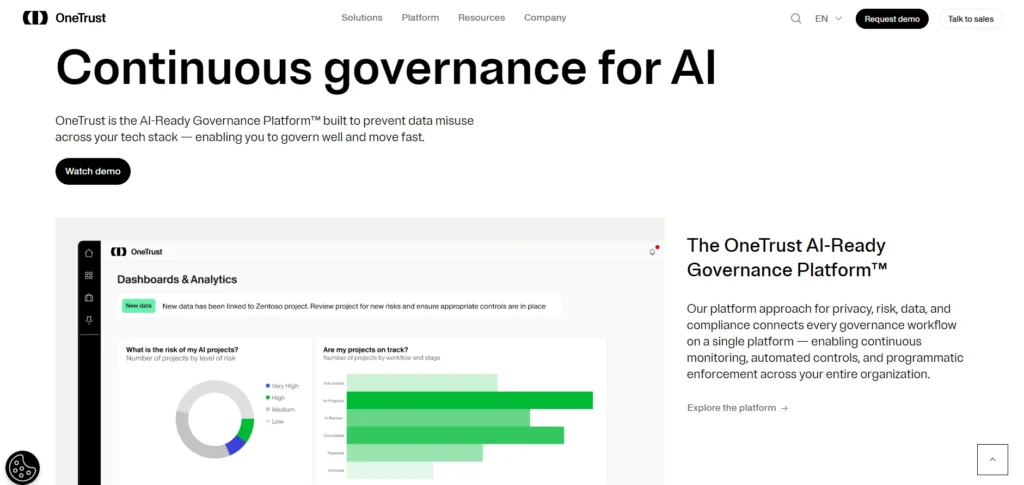
OneTrust is best known as a privacy-first platform built for scale. If your program starts with GDPR operations, DSAR intake, cookie consent, and data mapping across hundreds of systems, OneTrust is often the shortest path to a complete PrivacyOps backbone.
On the GDPR side, the platform’s depth is the headline. OneTrust supports core workflows like ROPA, DPIAs, DSAR portals, cookie consent, consent management, and data mapping, with guided playbooks that help privacy teams standardize how work gets done across regions and business units. Instead of treating Article 30 documentation as a one-time export, you can build a living record tied to owners, purposes, and the underlying systems that process personal data.
OneTrust also extends into security and compliance, largely through its Tech Risk and Compliance suite, which comes from the Tugboat Logic acquisition. This gives you framework templates, policy libraries, and evidence workflows for programs like SOC 2 and ISO 27001. The trade-off is automation depth. Compared to automation-first platforms, OneTrust’s compliance module is typically less “set it and forget it,” with fewer integrations, fewer automated tests, and less frequent monitoring. For teams that want continuous evidence collection at high cadence, that difference shows up quickly during audit preparation.
For third-party risk, OneTrust’s strength is breadth and workflow. Vendorpedia can speed up assessments with pre-built vendor profiles and questionnaires. If you need continuous vendor monitoring, plan for additional tooling. Out of the box, that signal usually comes through integrations with providers like BitSight or SecurityScorecard, which can add cost and complexity.
OneTrust does offer ways to share assurance externally, but its customer-facing trust experience is more limited than platforms built around a dedicated Trust Center.
Implementation is usually a program, not a quick rollout. Many enterprise deployments take several months, often staged—privacy first and then security, risk, and third-party workflows. Teams also frequently cite a learning curve, which is the natural consequence of adopting a broad platform with many modules.
OneTrust is ideal for:
- Global enterprises and regulated industries that need a full PrivacyOps suite, including cookie consent and DSAR automation
- Organizations that want one platform spanning privacy, governance, and risk workflows, and have the resources to run a phased rollout
- Teams that value pre-built privacy playbooks and vendor profile libraries, even if security compliance automation is lighter
Pricing: OneTrust pricing is typically opaque and module-based, with enterprise annual costs commonly running well into six figures depending on what you deploy. Cookie consent can be priced as its own line item, and implementation fees are commonly additional.
Key differentiators: Deep privacy capabilities, broad governance coverage, and vendor assessment acceleration via Vendorpedia.
Key limitations: SOC 2 automation and monitoring cadence are less advanced than continuous-compliance specialists. Implementation can be lengthy, and the platform’s breadth can translate into a steeper learning curve.
3. Thoropass: audit-aligned compliance for growing security programs
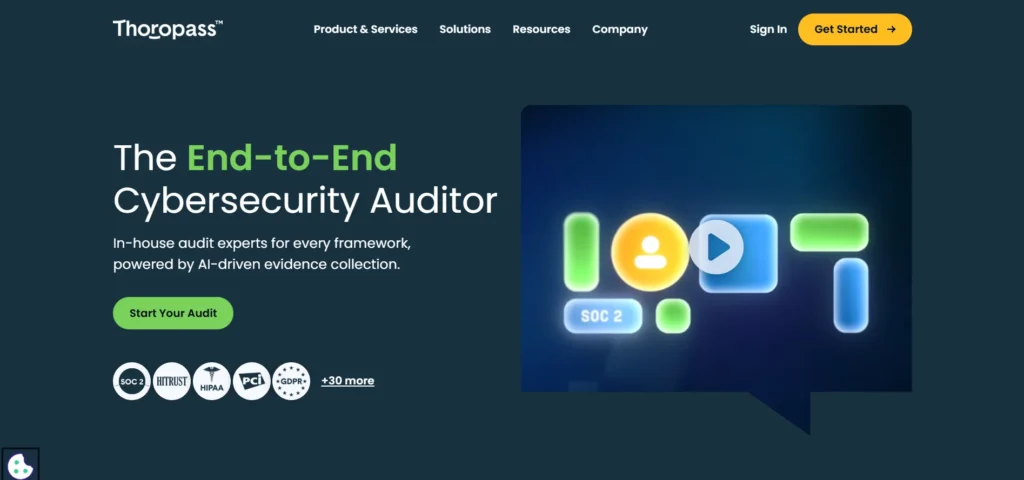
Thoropass is a compliance management platform built around a single idea: the software you use to prepare should be the same software your auditor uses to test. Because Thoropass pairs its platform with in-house audit services, the workflow from evidence collection to auditor sign-off stays inside one system, which removes a lot of the handoff friction teams hit during their first or second SOC 2.
For SOC 2 and security compliance, Thoropass ships with pre-mapped frameworks, policy templates, and automated evidence collection across common cloud, identity, and developer tooling. Control owners are assigned, remediation items are tracked inline, and auditors review live evidence rather than point-in-time screenshots. That same approach extends to multi-framework programs, so teams preparing for ISO 27001, HIPAA, or PCI can reuse controls and evidence without rebuilding each program from scratch.
On GDPR, Thoropass supports the security-oriented slice of the regulation. It helps you map technical and organizational measures—encryption, access management, incident response, and vendor due diligence—against GDPR requirements, which is useful when you already have a privacy program in place and need the security evidence to line up. What it does not provide is a deep operational privacy layer. There is no native ROPA builder, no DPIA workflow, no DSAR automation, and no cookie consent tooling, so privacy operations typically live in a dedicated privacy platform and plug into Thoropass for control evidence.
Vendor risk management is included, but it is not the platform’s main thrust. Thoropass offers vendor inventory, questionnaire workflows, and documentation for due diligence, which works well for teams with a moderate vendor footprint that want TPRM tracked inside their compliance system of record. If you need shadow IT discovery, continuous vendor monitoring, or large-scale questionnaire automation, expect to supplement with a dedicated VRM tool.
Thoropass also supports sharing assurance externally, with compliance reports and documentation that can be shared with prospects under NDA. It is not as Trust-Center-centric as platforms that lead with a public portal, so if your go-to-market motion depends heavily on a branded trust page, plan accordingly.
Implementation is typically quick relative to enterprise GRC suites. Many teams reach audit-ready status in roughly a couple of months, with the on-staff audit team providing guidance throughout readiness and fieldwork.
Thoropass is ideal for:
- Growing companies running their first or second SOC 2, ISO 27001, or HIPAA audit that want software and audit services in one place
- Security and compliance teams that value auditor-in-the-platform collaboration over a purely self-serve model
- Organizations that already run privacy operations (ROPA, DPIAs, DSARs) in another system and want a single system of record for security compliance and vendor due diligence
Pricing: Thoropass pricing is not publicly disclosed. Packages are typically bundled with audit services, which helps teams forecast total audit cost up front instead of paying software and audit fees separately.
Key differentiators: Tight integration between compliance software and in-house audit services, strong multi-framework reuse, and a workflow that keeps preparation and audit fieldwork in the same system.
Key limitations: Limited GDPR privacy operations support (no native ROPA, DPIA, DSAR, or cookie consent), lighter TPRM capabilities than dedicated VRM platforms, and less emphasis on a customer-facing Trust Center.
4. TrustCloud: risk-driven GRC with a free tier for early-stage teams
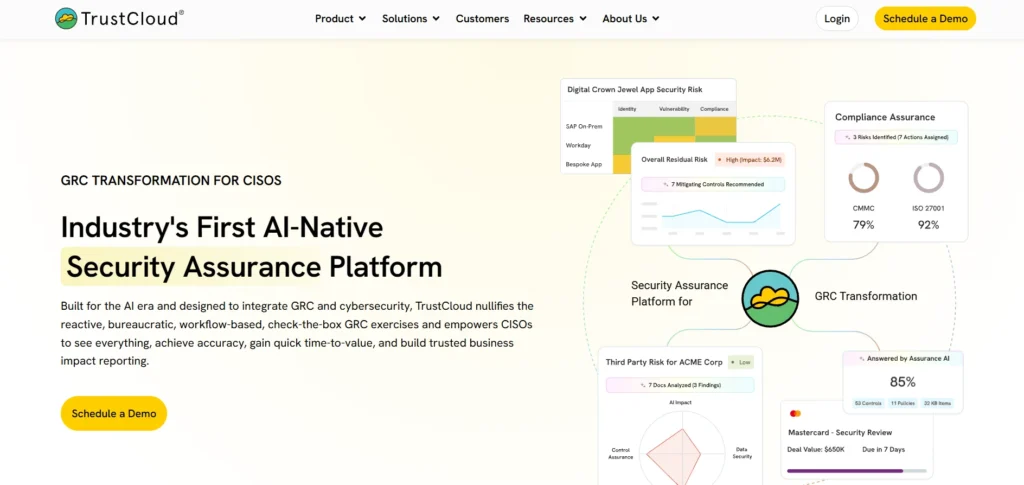
TrustCloud takes a slightly different angle on compliance automation. Rather than starting from a framework checklist, it starts from a risk register and uses that risk view to drive which controls, evidence, and monitoring activities matter for your program. For teams that want their security narrative to hang off risk instead of audit line items, that framing can be a better fit.
For SOC 2 and broader security compliance, TrustCloud offers pre-built frameworks, policy templates, and automated evidence collection across cloud and SaaS systems. Controls are tied back to the underlying risks they mitigate, which helps teams explain “why this control exists” to executives and auditors alike. TrustCloud also supports multi-framework reuse, so work done for SOC 2 can be applied to ISO 27001, HIPAA, and similar programs without rebuilding from scratch.
On GDPR, TrustCloud focuses on the security and risk-management side of the regulation. It maps controls such as encryption, access management, vendor due diligence, and incident response to GDPR-aligned requirements and ties them into the risk register, which is useful when you want a single view of technical safeguards across frameworks. TrustCloud does not provide deep privacy-operations modules. There is no native ROPA builder, no DPIA workflow, and no DSAR or cookie consent tooling, so privacy-first work typically remains in a dedicated privacy platform.
Vendor risk management is included and integrates with the platform’s risk-first approach. You can maintain a vendor inventory, run due diligence questionnaires, and track vendor-related risks alongside your internal controls. For organizations that need shadow IT discovery, large-scale questionnaire automation, or deep continuous monitoring, a dedicated VRM tool is still a useful companion.
TrustCloud includes a customer-facing Trust Center option, so teams can share compliance posture, policies, and reports with prospects through a branded portal. It is less feature-rich than platforms that lead with trust portals, but it is a meaningful step up from sharing PDFs over email.
Implementation speed depends on scope, but TrustCloud is notable for offering a free tier aimed at early-stage teams, which lets you start mapping risks, controls, and evidence before committing to a full enterprise rollout. Teams moving to a paid tier typically reach audit-ready status in a few weeks once their core integrations are connected.
TrustCloud is ideal for:
- Early-stage and mid-market teams that want a risk-first compliance story and a low-cost on-ramp to GRC tooling
- Security leaders who want controls and evidence tied back to a living risk register rather than a static framework checklist
- Organizations that already manage privacy operations elsewhere and want GRC, risk, and basic TPRM consolidated in one workspace
Pricing: TrustCloud offers a free tier for core risk and compliance tracking, with paid plans for deeper automation, multi-framework coverage, and Trust Center features. Full pricing is generally quoted based on scope.
Key differentiators: Risk register at the center of the platform, strong linkage between risks and controls, and a free tier that lowers the barrier to entry for smaller teams.
Key limitations: No native ROPA, DPIA, or DSAR modules; lighter TPRM depth than dedicated VRM platforms; and a Trust Center that is functional but less feature-rich than trust-first competitors.
5. Hyperproof: flexible control hub for multi-framework jugglers
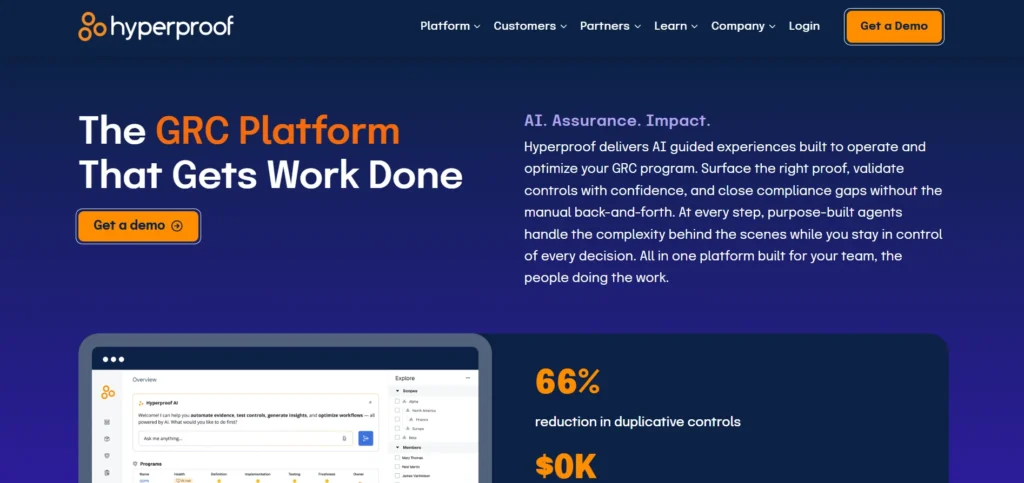
Hyperproof is a compliance operations workbench. It is built for teams that want to design their own control catalog, map it across many frameworks, and keep an audit trail of evidence and remediation. If you already have a mature program and need a system of record that can match your internal structure, Hyperproof can be a strong fit.
Where it shines is cross-framework mapping. Hyperproof supports importing frameworks like GDPR and SOC 2, then linking controls and evidence across them. Its Jumpstart capability is a real differentiator for mapping existing controls across many frameworks, which helps reduce duplication when your program spans multiple standards and customer requirements.
For GDPR privacy operations, set expectations early. Hyperproof does not provide native modules for ROPA, DPIAs, or DSAR automation. You can build custom fields and workflows to track processing activities, owners, and systems, but the privacy “ops” layer is largely something you model yourself rather than a guided, purpose-built GDPR experience.
On SOC 2 and security compliance, Hyperproof is more configurable than automated. It offers integrations, but the footprint is smaller than continuous-compliance specialists, and the included connectors (Hypersyncs) cover the essentials rather than a sprawling catalog. More importantly, control testing is not out of the box in the way buyers expect from continuous compliance platforms. Tests require manual configuration, and there are no pre-built automated tests, no auto-generated System Description, and no AI remediation to speed up fixes when evidence goes stale or a control fails. Even policies are modular—the policy module is a paid add-on with a small set of templates.
Hyperproof can still work well in environments where evidence already lives in tools like Jira and Slack, and you primarily want a central place to manage relationships across controls, risks, and artifacts. Customers commonly describe their usage as managing the framework more than running automation, which is consistent with a workbench-style tool.
Third-party risk management is also not native in the way many buyers want for GDPR plus SOC 2 consolidation. Hyperproof does not include built-in questionnaire automation. Instead, it typically partners with HyperComply, which uses a human-backed SLA model. Hyperproof also lacks automated vendor discovery and continuous vendor monitoring, so teams often need additional tooling or manual processes to run a scaled TPRM program.
If you need a customer-facing Trust Center, note that Hyperproof does not offer one natively. That experience is generally handled through the HyperComply partnership.
Implementation timelines vary heavily by scope. Small deployments can move quickly, but broader rollouts across multiple frameworks take longer, and Hyperproof offers paid implementation services. Reviews also point to a steeper learning curve, which is common for highly flexible platforms.
Hyperproof is ideal for:
- Mid-market and enterprise teams that already have a defined control strategy and want a flexible system of record
- Organizations juggling many frameworks where cross-mapping and audit trails matter more than automated testing cadence
- Programs that are comfortable pairing a mapping tool with separate solutions for privacy ops or vendor questionnaires
Pricing: Hyperproof pricing is not publicly disclosed. Buyers typically see three tiers (Professional, Business, Enterprise), an unlimited-user model, and a paid add-on for the policy module. Mid-market deals land in the mid five-figure range based on third-party benchmarks.
Key differentiators: Strong cross-framework mapping (Jumpstart), flexible control workbench, unlimited user model.
Key limitations: No native ROPA, DPIA, or DSAR tools; a modest integration footprint; manual test configuration with no pre-built automated tests; no native Trust Center; and limited TPRM depth without partners.
6. MetricStream: enterprise GRC muscle for complex environments
MetricStream is built for organizations that treat governance and risk as an enterprise operating system, not a lightweight audit project. It uses a Unified Control Framework approach, with thousands of control statements mapped to over a thousand regulations, so you can build one control view and roll it up across business units, geographies, and regulatory obligations.
For GDPR privacy work, MetricStream can support the right processes, but it does so through configuration. You can set up privacy compliance management workflows like DPIA surveys, assign controller responsibilities, and manage DSARs as cases. The upside is flexibility in complex org charts and approval chains. The downside is that GDPR privacy operations are not “turnkey” in the way privacy-first platforms are. You should expect design work to get to a clean ROPA-like system of record that matches how your company actually operates.
On SOC 2 and security compliance, MetricStream is not a typical “SOC 2 automation” tool. It does not provide a native SOC 2 audit-readiness workflow, and it does not ship pre-built frameworks in the same way compliance automation platforms do. Much of the model is driven through UCF configuration. MetricStream can help manage controls and orchestrate remediation across your GRC program, but it is not designed to get a company to its first SOC 2 report through out-of-the-box evidence automation.
Where MetricStream stands out is third-party risk management (TPRM). This is the crown jewel for teams with large vendor ecosystems and strict oversight requirements. MetricStream supports full-lifecycle vendor risk workflows and extends into fourth-party visibility, with integrations like BitSight, D&B, and Dow Jones. It can also scan vendor SOC reports using AI-powered SOC report scanning, which helps scale reviews when procurement volume is high.
MetricStream does not offer a customer-facing Trust Center, so if your goal is to publish assurance externally and reduce inbound security review friction, you will need a separate trust portal approach.
Implementation is a major consideration. MetricStream deployments typically run for the better part of a year, often involving a systems integrator. In practice, this is a program with meaningful change management and services spend. Customers commonly note that the platform’s configurability translates into meaningful additional spend that should be scoped before signing.
Pricing: MetricStream pricing is not publicly transparent. Enterprise deployments commonly land in the high six- to seven-figure annual range depending on scope, plus implementation and customization fees.
MetricStream is ideal for:
- Large, regulated enterprises with mature GRC and procurement functions
- Organizations where TPRM depth and cross-regulation governance outweigh “fast SOC 2 automation”
- Teams that can invest in configuration, implementation partners, and long-term platform ownership
Key differentiators: Enterprise-scale control framework breadth, strong regulatory and risk program alignment, and deep TPRM capabilities including fourth-party visibility and SOC report scanning.
Key limitations: Heavy configuration and customization burden, with customer feedback commonly describing setup as effort-heavy, and an AI maturity that some customers describe as still developing. It is also not a SOC 2 audit automation platform for customers, and it lacks a customer-facing Trust Center.
Frequently asked questions
What exactly is a ROPA, and do we really need one?
A Record of Processing Activities (ROPA) is the GDPR-required ledger of how your organization processes personal data. GDPR Article 30 makes it compulsory for most organizations, and regulators often ask for it early in an inquiry. A living ROPA helps you show where data lives, why you process it, who owns it, and how long you retain it. That context is critical during audits and breach response.
How do SOC 2 and GDPR overlap?
They overlap most on security controls. Both expect strong access management, encryption, vendor due diligence, and incident response. SOC 2 evaluates how well your organization meets trust criteria. GDPR safeguards individual rights and requires appropriate technical and organizational measures. A unified GRC platform helps because you can collect evidence once and apply it to both requirements, instead of duplicating tests and screenshots.
Can software guarantee GDPR compliance?
No. Software helps you operationalize compliance. It can automate evidence collection, centralize documentation, and surface gaps. You still need clear policies, training, ownership, and executive accountability to make those workflows real.
We’re a five-person startup, do we need GRC software now?
If you handle EU customer data, GDPR obligations already apply. The question is timing and effort. Getting your policies, monitoring, and documentation in place early often reduces the scramble later, especially when an enterprise buyer asks for proof or a regulator asks for records.
Should we choose SOC 2 or ISO 27001 first?
Choose the framework your buyers expect. US customers often ask for SOC 2. Global enterprises often prefer ISO 27001. Most of the underlying technical controls overlap, so the right platform and control mapping approach can help you work toward both without doubling the workload.
Conclusion and next steps
Unified GRC platforms are no longer nice-to-have. They are one of the fastest ways to reduce duplicate work, shorten audit cycles, and surface risks earlier. When privacy and security teams share the same controls, evidence, and ownership, compliance stops being a quarterly scramble and starts running in the background.
To choose well, get specific about what you need first. Is your priority an automated ROPA, continuous monitoring, cross-framework mapping, or deeper vendor risk tracking? Then shortlist two or three tools from this guide that match your scope and company size, and book live demos. Ask vendors to show your exact workflow, not a polished slide deck.
During trials, pressure-test the product with real work:
- Upload a real policy
- Connect a real cloud account
- Export a real report you would hand to an auditor or customer
If the workflow feels clunky in week one, it will not feel better in month six. Finally, pull legal, security, and finance into the decision early so implementation, resourcing, and total cost are aligned before you sign anything.
Choose the right platform and you spend less time managing spreadsheets and more time building a trust program that scales with your business.
Go unify that checklist.


