

If you are looking to launch a daycare business in India, you are not alone. You’re not the only one thinking about How to Start a Daycare in India, but you don’t know where to start. Daycare is not only a booming need for working parents, but it is also a beautiful business opportunity to make a little money while helping children learn, play, and feel safe. This is a simple guide for beginners and parents who want to set up a real and registered daycare business, even if they have no experience.
You’ll learn how to research demand in your area, plan your budget, follow Indian regulations, set up a safe and child-friendly environment, hire and train staff, decide your fees, and attract your first admissions with smart but affordable marketing. By the end, you will have a simple, actionable plan to take your idea from “I wish I could open a daycare” to opening your doors with confidence and care.
What is a Daycare Business?

A day care is a safe, supervised, and trained environment where children between the ages of 0 – 5 years and their parents or guardians can have access to care while parents/caregivers are working or running errands; children develop friendships and learn simple learning activities with other children, and learn routine and social skills in a safe, supervised environment.
Child care centres — Full-day centres that provide care for several children in a group of the same age; they are usually larger, have a license, and have an age-appropriate structure for learning, meals, and schedules.
Types of Daycare Businesses
- Family child care homes – Childcare in the childcare giver’s home for a small number of children, may be more flexible with hours, and may have lower child-to-adult ratios, feel like home.
- Care in the home / Nannies — Care is offered in the child’s home, on a one-to-one or small group basis; it is highly individualised and convenient, and typically more expensive than centre-based care.
- Babysitter / Occasional care — Care of a child on an informal, short-term basis, such as for a few hours, and not subject to the same regulations as licensed care.
- Child care centers — These are larger, licensed, child care facilities that provide care for multiple children in one group, organised by age and typically have full-day programs, are regulated, and provide structured learning, meals, and schedules.
- School-age / After-school programs — Care for children before and/or after school and during holidays, including homework help and supervised play and activities when parents are at work.
- Drop‑in / hourly care centers — Flexible, short-term care by the hour for working parents who require occasional coverage during the day; great for running errands, appointments, or part-time jobs.
- Faith‑based or community daycare — These are childcare facilities provided by a religious institution or community organisation; these may include values based activities and may provide members with subsidised fees.
- Special needs care programs — Daycare or therapy integrated care programs that are staffed by trained professionals and may have individual care plans for children with developmental, medical, or behavioural needs.
Why Start a Daycare Business In India?
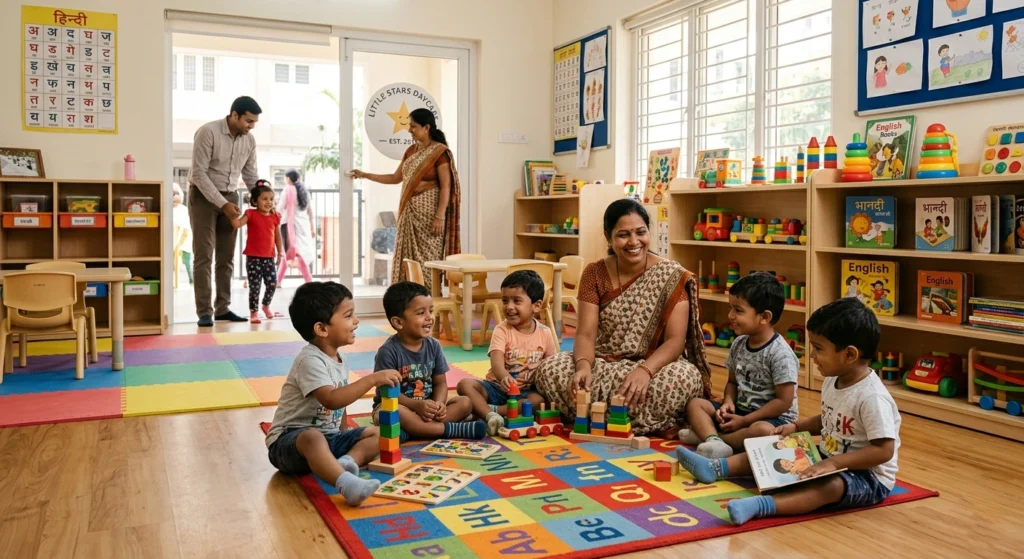
There are many reasons to starting a day care business in India: there is a growing need for day care facilities, it can be financially rewarding, it will help working parents, and it can be socially rewarding.
- Parents work and are in need of childcare. There is a constant demand as many families are both working and also some single parents who require secure and reliable childcare during working hours.
- An increasing nuclear family system in urban areas. As more families live in “nuclear” households in cities, fewer relatives will care for the children, which will lead to more use of daycare facilities.
- Good repeat revenue. They charge a monthly or daily fee from the parents. When they trust you, you will have a regular income and make some cash flow.
- Positive social impact. You provide early childhood development services to children, and you have parents’ peace of mind while you are personally rewarding their children.
- Moderate start-up flexibility. Deliver a small project (home-based) or a full centre-based project as per budget and demand.
- Government/bank support options. Setup costs may be covered by some loans or grants, or schemes for women entrepreneurs (depending on the location).
- Positive long-term growth prospects. Market size grows as more parents become part of the formal workforce and become more concerned with early education.
- Referrals are fostered by community trust. The happier parents are, the more they will recommend to neighbours and colleagues, reducing the cost of customer acquisition.
- Flexible operating models. Home daycares, centre-based, corporateorate, apartment/crèche, and office-based daycares are all acceptable.
- Scope to specialise. Niche services (special-needs care, Montessori, language immersion) enable you to charge higher rates and make yourself more prominent.
Steps to Start a Daycare Business
Below is a step-by-step list of how to begin a daycare business:
- Determine your day care style and age range: Determine whether you will operate a home-based daycare or a centre-based daycare, and the age groups in which you will open your daycare (infants, toddlers, preschool). This affects the costs, space, staff requirements, and licensing.
- Do some research on the local market: Research other daycares, demand from parents, neighbourhood and demographic characteristics, and expected cost to ensure you will be able to determine your pricing and find the right spot or niche.
- Create a brief business plan: Incorporate services, rates, approximate monthly costs, income projection, and simple policies (hours, holidays, sick child policies). Keep it simple to stay organised, and it’s helpful for loans and partners.
- Decide on a legal structure and registration: Choose between sole proprietorship, partnership, partnership or company, and register your business name with the local authorities to run your business legally and open a business bank account.
- Understand and abide by licensing laws: Identify and adhere to local regulations for childcare licensing (staff/child ratios, safety and health inspections). Compliance is essential to open and to gain parents’ trust.
- Arrange insurance and safety measures.: Buy liability and property insurance, install safety devices – childproofing, fire extinguishers, first-aid kits, secure exits, and safe play areas.
- Set up and purchase materials: Provide learning/play spaces, nap spaces, bathrooms, and outdoor play space (if available); purchase appropriate toys, cots, changing supplies, cleaning materials, and basic classroom materials.
- Develop policies and Parent Contracts: Legally protective and understandable policies for fees, drop off/pick up, sick-child regulations, emergency protocol, and consent forms are all written. Fees, drop-off/pick-up, sick-child policies, emergency procedures, and consent forms have all been written in a way that protects both the parent and the school.
- Recruit and train: Use caregivers with experience in childcare and a background check, and teach them safety tips, child development, hygiene, and your daily schedule.
- Establish billing, record keeping, and fees: Set fees, deposit/withdrawal conditions, and select a convenient payment option (apps or bank transfer). Establish a simple attendance, payment and incident record-keeping system.
- Organise curriculum activities and schedules: Develop age-appropriate play, feeding, rest, and learning schedules; children require consistency to be more secure.
- Promote to parents and register children: Leverage local parenting organisations, social media, flyers at clinics/schools, and word-of-mouth to show your parents your value; provide tours, trial days, or a clear brochure to let parents know what you’re worth.
- Do a soft opening first: Test routines, workflow, and communications with small groups first, then with larger groups; adjust processes according to feedback.
- Establish a good relationship with parents: Take notes, take pictures, publish newsletters and provide an accessible way for parents to get in touch with you on a daily basis – communication helps lead to trust and continued enrollment.
- Check and make improvements on a regular basis: Monitoror finances, child progress, parent feedback, and safety checks monthly, update procedures, training, and marketing as you develop.
Daycare License and Registration in India: Complete Legal Guide to Start a Childcare Business
This is a short and simple checklist of Licences, Registration, and Legalities which are generally required for starting a daycare/childcare business (créche/preschool) in India.
- Decide on a business structure: A sole proprietorship would be the most basic business structure for one owner, a Private Limited or LLP (Limited Liability Partnership) would be applicable for a profit business, and a Trust/Society/Section-8 company would apply to a not-for-profit business. This impacts taxes, liabilities, and financing.
- Open your Business Bank accounts: Register your business name/entity (GST/Company/LLP/Trust registration or local shop act/municipal trade licence) to open bank accounts, obtain loans, and receipts. Registration also fosters parent trust.
- Udyam / MSME registration (optional): Small businesses can avail government schemes, loans, and certain subsidies if registered as an MSME; it is an optional process.
- Municipal trade licence / local shop & establishment registration: Obtain a licence from the municipal corporation or local authority for a business that will be operating from your selected premises; the authority will inspect the premises for safety, zoning, and sanitation. This is normally necessary to be a legal business in the area.
- Fire safety NOC / Certificate: Fire safety clearance or NOC from the local fire department following inspection of the fire extinguishers, fire safety drills, and exits. This will help to keep the premises to the most basic fire safety requirements.
- Occupancy / no‑objection certificate from local authority and landlord: If you rent, obtain written permission from the Landlord and verify that the building has an occupancy certificate or they are zoned for an educational/commercial use. This will prevent closing or legal issues down the road.
- Health & sanitation / public health clearance: Make sure you have any municipal public health or sanitation clearance (food preparation, cleanliness, sewage) and adhere to basic hygiene guidelines to keep children healthy.
- Child Safety Policies & Staff Background Checks (Police Verification): Ensure written child safety policies (no corporal punishment, supervision rules, etc.) and/or ensure that staff is verified or have documented identity proof (police verification is expected by many parents & authorities).
- Staff qualifications & teacher-student norms: Ensure that staff and teachers are qualified, and have a staff/child ratio (varies by age), some states recommend minimum training/qualifications for caregivers. Safety and quality require appropriate staffing.
- First aid/emergency plan/medical consent forms: Have a trained first aid person present, a first aid kit, Emergency plans, and evacuation plans documented, and parental medical plan consent forms signed for emergencies. These are safety essentials to have and are very useful.
- Insurance (liability/accident/property): Purchase business insurance for public liability, child accident, and property insurance to minimise financial loss should an accident or damage occur.
- Income tax and GST compliance: Register for PAN and adhere to the rules of income tax for your entity. GST is not applicable for preschool education services; check current rules and your services (e.g., daycare + taxable add-ons) on the GST official website talk to an Accountant for proper filing.
- Protection of Children (legal compliance awareness): Know the national child protection legislation (such as Juvenile Justice and Child Protection policies) and reporting requirements for child abuse and have procedures in place to escalate concerns;
- Check state education/preschool rules (where applicable): Some states have specific rules or voluntary registration schemes for preschools/playschools. Please check your state education department for any necessary approval or recommended registration. The requirements differ greatly from state to state.
- Juvenile Justice Act / Child Care Institution registration (only for special care homes): If you are going to operate a child care institution for children who require protection, they must be registered under the Juvenile Justice framework; it is not usually the case for ordinary daycare centres.
- Accessibility & building safety standards: Make sure premises have safe play areas, non-toxic materials, safe stair/rail protections, and reasonable accessibility; adhere to basic building safety rules for children.
- Data privacy & consent: for photos/records: Ensure records are kept securely, and a written parental consent is sought for the collection of data, sharing of photos or medical information, to preserve data privacy & trust.
- Records & periodic renewals: Carry out records of attendance, staff, medical records, accident, fire-fighting certificates, and renew licences (municipal, fire, FSSAI) as required. Keeping good records makes inspections and compliance easy.
Franchise vs. Independent Daycare: Which One Should You Choose?
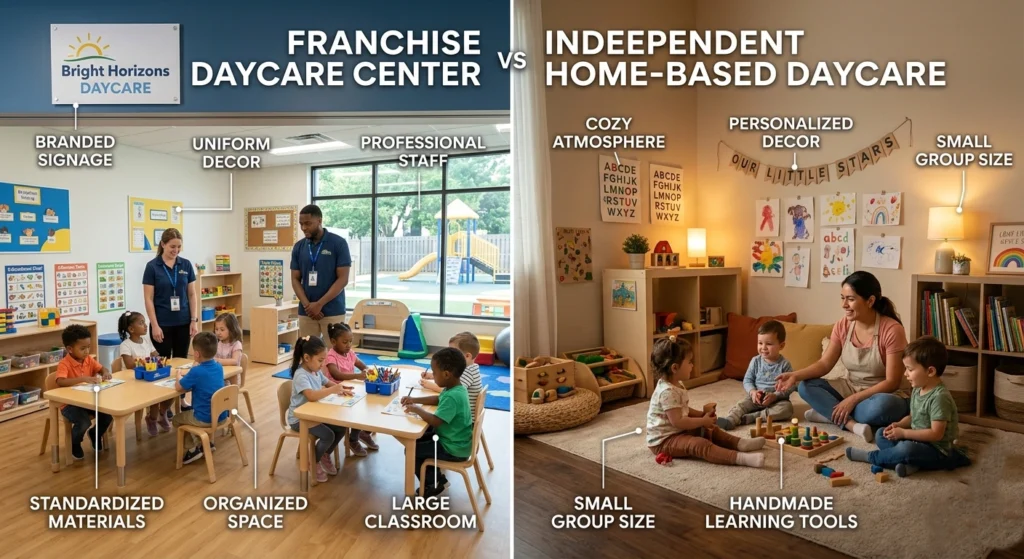
Choose a franchise if you want faster openings, brand trust, training, and lower startup risk; choose independent if you want full control, lower ongoing fees, and freedom to customise your program.
Who Should Consider Starting a Daycare Business?
The people who have a passion for children and possess saint-like patience and enjoy creating educational experiences through play should consider establishing a daycare business. The business provides an ideal opportunity for former teachers and nannies who have experience with childcare to work flexible hours while earning a consistent income from parents who need daycare services to observe their children’s development. The user needs to demonstrate organisational skills which enable them to manage safety protocols , complete licensing documents and create daily timetables, and resolve unexpected diaper emergencies.
Your ability to manage business operations through budgeting, toy and snack expenses and local advertising to parents, and maintaining a tidy and pleasant environment establishes this business model as your genuine method of creating a community space for income generation. The operation requires dedication and effort and a strong need for personal growth to succeed during periods of parent pickups and nap-time activities.
Common Mistakes to Avoid To Start A Daycare
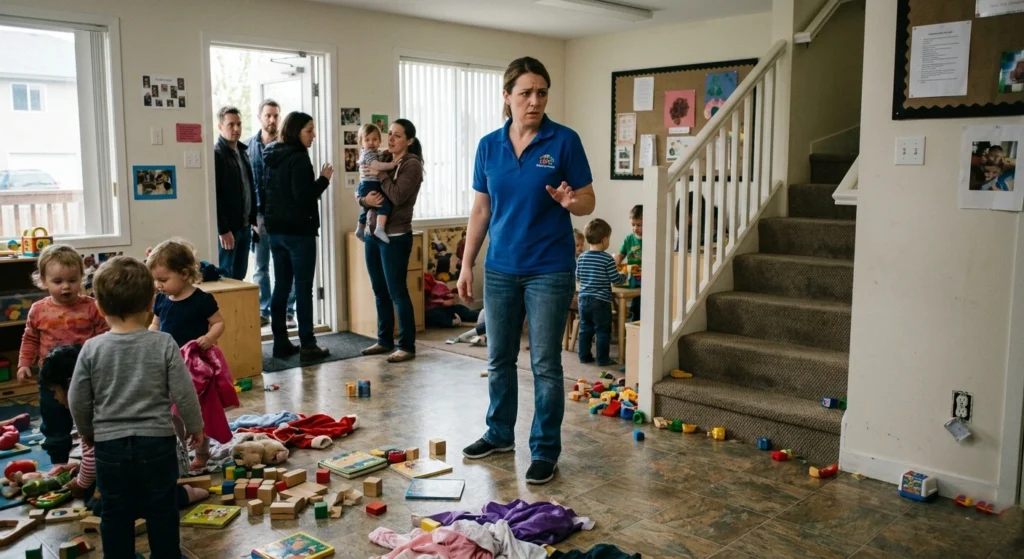
These are Common Daycare Start-Up Mistakes—to Avoid
- Misjudging start-up and operating costs. New owners often fail to account for renovations, licensing, insurance, staff, supplies, a cash buffer, and end up with cash shortfalls early on.
- Neglecting licensing, zoning, and regulatory requirements. If you don’t have the proper licenses, inspections, and background checks, you’ll get fined, shut down, and lose credibility.
- Hiring the wrong staff or lacked proper training. The wrong hiring decisions (or cutting corners on training) are a safety and care risk, lead to high turnover, and result in bad reviews.
- Failing to have clear policies and procedures. If you don’t have written health, safety, discipline, drop-off/pick-up, emergency, etc., policies in place, staff will be inconsistent, and parents will be frustrated.
- Weak child-safety and facilities planning. If childproofing, equipment, or emergency procedures are lacking, you’ll increase injury risks and be exposed to liability.
- Neglecting insurance coverage. If policies like, liability, property, and abuse/maltreatment are lacking, you’ll be personally and financially exposed.
- Failing in financial accounting and pricing. If tuition isn’t priced correctly, cash flow isn’t tracked, or payments aren’t collected properly, you’ll find yourself in trouble even with a full class.
- Neglecting marketing and enrollment strategy. Relying on walk-ins and word-of-mouth without a website, local outreach, and referral strategy means income is shaky and enrollment is slow to grow.
- Failing in parent communication and relationships. Poor communication or lack of communication leads to mistrust, more withdrawals, and bad reviews.
- Trying to do everything and chasing every trend. Offering too many services, changing programs constantly, or waiting for the “right” moment leads to delayed opening and poor quality. Start simple and grow deliberately.
Suggested Read:
Conclusion
One way to start a business in India is to start a daycare. You can combine business with some heart by satisfying the needs of busy working parents and giving kids a safe and friendly space to learn and play at the same time. If you are searching for How to Start a Daycare, follow the guide below—from choosing your style and location, acquiring the needed licenses (like municipal trade licence and fire department NOC), creating a child-proof environment with trained personnel, and utilising social media and word of mouth for marketing—you can build a successful business without losing your mind.
Demand is consistent among nuclear families in cities like Delhi; start-up costs are low (home-based or franchise), and there are additional services you can offer, such as meals or pick-up. You can create reliable cash flow, earn the community’s trust through happy referrals, and make a difference in many little lives—all while avoiding common mistakes like cost underestimation and underpricing insurance.