
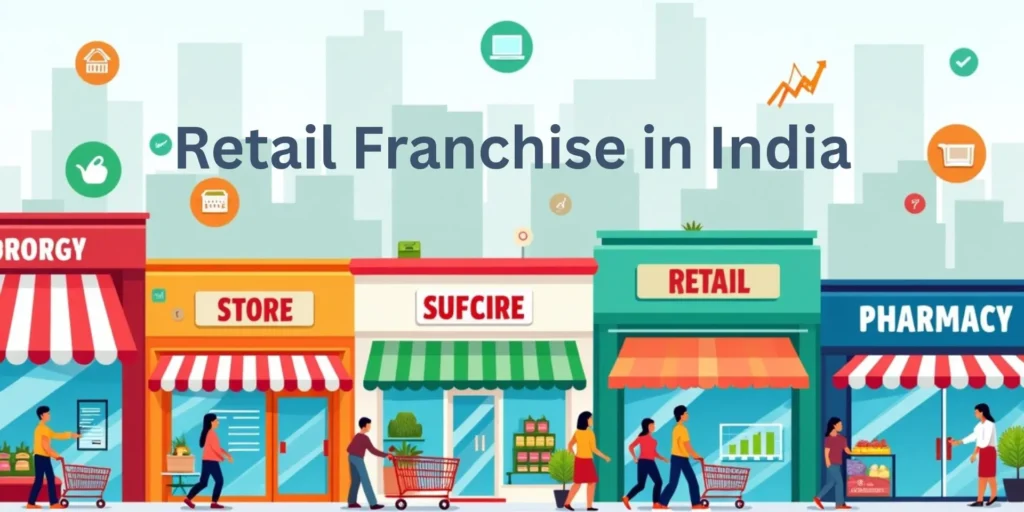
India’s retail industry is on the verge of a huge change, which makes a retail franchise in India one of the most promising business areas for 2026. As per some forecasts, the market is poised to expand beyond $1.7 trillion by 2027, and no one can deny the upward growth trend. The growing middle class, increasing disposable incomes, and the rapid penetration of organized retail in Tier 2 and Tier 3 cities are the main factors behind this growth.
By getting into a retail franchise India, entrepreneurs can avoid the hardships of brand building and business model testing, thus providing a safe and sure way to profit. The low-cost entry points, available for example, in the FMCG and express services sectors, are also facilitating the spread of entrepreneurship across the nation. In this article, we will go through the best 10 retail franchise opportunities along with the detailed investment costs, popular brands, and major market trends.
The Rise of the Retail Franchise Business Model in India
The franchise model has altered the way companies leverage brand recognition and established processes for rapid scaling. This comprises:
- Established Brand Recognition: It drastically reduces the time and cost that would be needed to gain a customer base from scratch, thus giving an instant market advantage.
- Proven Business Model: It equips franchisees with the support of detailed manuals, software, and training, thus significantly lowering the risk of startup mistakes that could become costly.
- Centralized Supply Chain: It gives individual franchisees the opportunity to enjoy the franchisor’s purchasing power for better margins and steady product availability.
- Reduced Marketing Cost: Benefits every outlet, as national campaigns funded by the franchisor drive footfall to local retail franchise India locations.
- Faster Path to Profitability: It results from the use of already existing customer demand and a tried product mix, thus making the break-even period shorter than that of independent startups.
Why Invest in a Retail Franchise Now?
Investing in a retail franchise India at the present time is truly a great opportunity, which is mainly driven by significant consumer and economic shifts. This includes:
- Digital Integration: Presently, many franchises can provide completely integrated online-to-offline customer experiences; thus, a sales reach that goes far beyond the physical store is yours.
- Consumer Shift: Quality branded products are continually increasing, and part of the fuel is higher disposable incomes, especially in non-metro areas.
- Regulatory Stability: It is a result of the central team’s work with the franchisor, which hence helps the local franchisee to meet all the requirements of both national and local regulations.
- Availability of Credit: Banks are usually more willing to provide funds to a business that is based on a proven franchise model than to a brand-new independent venture.
- Tier-2/3 City Growth: They bring less competition and a lot of potential for a new retail franchise India to become the leader in the segment that it serves.
We suggest you to check this blog also Burger King Franchise
Investment Structure & Cost Breakdown
Knowledge of the monetary plan is of utmost importance before one ventures into the retail franchise in India.
Typical Cost Components in a Retail Franchise:
The amount of franchise investment may differ extensively depending on the stature of the brand and the size of the store. When mapping out the business, make sure that you factor in all of these components. This includes:
- Franchise Fee: A single-time payment made to the franchisor for the rights to use the brand name, trademarks, and the already existing operating system.
- Store Setup & Interiors: This includes the work done on the building, new furniture, fixtures, specialized lighting, and brand-mandated design elements for the outlet.
- Initial Inventory: The cost of the first batch of products with which you are going to fill your shelves before the official opening day.
- Equipment & POS: It is the list of things like cash registers, billing software, security cameras, computers, and any specially made equipment, such as freezers or ovens.
- Working Capital: Money that has been reserved to cover the initial operational costs, such as rent, staff salaries, utilities, and minor expenses, until the store starts generating profit.
Break-even Period / ROI (Retail Franchise)
The time it takes for an investor to get their money back (ROI) and the time it takes for the business to reach a break-even point are the leading indicators that attract the attention of a potential investor. These factors hugely depend on deciding the location of the company and the management’s quality; however, a stable retail franchise India usually assures the franchisee with the projected timeline. This includes:
- Quick Service Restaurants (QSR): Most of the time, within 12–18 months due to a large number of transactions and instant brand demand.
- Apparel & Lifestyle: It usually is 24–36 months before the initial investment is recovered, which depends on seasonal sales and brand marketing campaigns.
- Service-based Retail (e.g., Salon): This type of business gets to the break-even point in 18–24 months, and it is mainly supported by the loyal customer base and service packages.
- Low-Cost Kiosks (e.g., Ice Cream/Tea): Can sometimes break even in 6–12 months due to very low initial overhead and high margins on products.
- Premium/Luxury Retail: It might take from 36 to 60 months since the beginning of the investment, mainly because the focus is on low-volume but high-value sales, and the upfront capital is much larger.
Retail Outlet Formats in India
The Indian retail landscape is becoming dynamic, with brands strategically choosing store formats to optimize cost and reach. The trend for a retail franchise India is moving away from the “one size fits all” approach to highly focused, location-specific models.
Full Retail Store
Simply the largest format of the traditional retail, it is usually available in the localities of high street, malls, and large commercial areas. A complete retail store is the place where customers are offered the brand’s full range of products, get a fully personalized brand experience, and also have access to the dedicated customer service department.
Kiosk / Pop-Up Retail
It is a smaller arrangement, which can be found in low or, very often, in high-footfall areas such as mall corridors, transit hubs, and outside large stores. Kiosks and pop-ups are employed for a certain range of products, a season’s sales, or to test new markets quickly with a minimal investment. There is no doubt that such a point of sale offers great visibility at a very affordable cost for a retail franchise in India without the constraint of a big lease.
Shop-in-Shop Concept
The shop-in-shop model involves a brand renting a dedicated space inside a larger, non-competing store (e.g., a cosmetics counter inside a department store). This allows the brand to use the footfall of the anchor store, reducing independent marketing effort and capitalizing on a shared customer base.
Mobile / Express Units
They are smaller-sized, sometimes movable, business models focusing on quick transactions and takeaway. They are very popular for food, refreshments, and express services such as laundry or courier pick-up.
How Brands Choose Formats to Optimize Cost and Reach
Brands decide on the format of their stores after conducting a very detailed analysis of the local demographics and rent costs. This comprises:
- Market Penetration: The brands in new cities usually opt for Kiosks or Shop-in-Shops to test the waters before committing to a Full Retail Store.
- Product Fit: Products such as jewelry or electronics need the security and space of a Full Retail Store, whereas snacks are more suitable for a Mobile/Express Unit.
- Rental Cost: Lead brands to choose smaller formats like Mobile/Express Units to maintain profitability and reduce overhead costs.
- Customer Traffic: Being in malls or transit hubs, Kiosks are there because they can attract the passing foot traffic for the purpose of making quick purchases.
- Brand Experience: Brands such as FabIndia and Kalyan Jewellers need the space of a Full Retail Store in order to deliver their entire product and service experience.
We suggest you to check this blog also Haldiram Franchise Cost
Top 10 Retail Franchise Opportunities in India for 2026
| Brand Name | Sector | Investment Range | Key Highlights |
| Lenskart | Eyewear Retail (Omni-channel) | ₹30 Lakhs – ₹40 Lakhs | Technology-driven model (virtual try-ons), high product margins, rapidly expanding market, integrated online/offline sales. |
| AMUL | FMCG Retail (Dairy/Snacks) | ₹2 Lakhs – ₹6 Lakhs | Very low investment for parlor model, essential goods category, high brand trust, and large sales volume. |
| FabIndia | Ethnic Apparel & Lifestyle | ₹75 Lakhs – ₹1.5 Crores | Comprehensive ethical brand story, targets affluent, conscious consumers, unique focus on Indian handicrafts/artisans. |
| Kalyan Jewellers | Luxury Retail (Jewellery) | ₹2 Crores – ₹5 Crores+ | High transactional value, trust-based business model, significant marketing, and steady demand for gold/precious stones. |
| The Body Shop | Personal Care & Wellness | ₹40 Lakhs – ₹60 Lakhs | Globally recognized ethical brand, premium positioning, strong commitment to cruelty-free/vegan products, high repeat purchases. |
| Lakmé Salon | Beauty & Wellness Services | ₹50 Lakhs – ₹1 Crore | Backed by Hindustan Unilever (HUL) brand strength, service-based model with high-repeat customer revenue, professional training. |
| Miniso | Value Retail / Lifestyle | ₹50 Lakhs – ₹70 Lakhs | High-frequency shopping model (fast-changing inventory), appealing product mix (low-cost, trendy goods), strong supply chain/margins. |
| DTDC | Courier & Logistics | ₹50,000 – ₹2 Lakhs | Very low startup cost, essential service benefiting from e-commerce boom, small retail area requirement, quick return on investment. |
| Digit Insurance | Service (Insurance/FinTech) | ₹1 Lakh – ₹3 Lakhs | Micro-franchise (POSP) model, service-based, very low overhead, high commission/fee structure, future-ready segment (digital focus). |
| Uncle Peter’s Pancakes | QSR (Desserts) | ₹10 Lakhs – ₹20 Lakhs | Niche dessert focus (pancakes, waffles), moderate investment for QSR, simple menu for ease of operations, strong social media appeal. |
Top 10 Retail Franchise Opportunities in India – Detailed Analysis
1. Lenskart

Lenskart has become the most popular eyewear brand in India and is rightly considered to be the first one to introduce the omni-channel retail franchise model in India by integrating its online platform with its physical stores seamlessly. The company was founded in 2008 (started operations in 2010) by Peyush Bansal, Amit Chaudhary, Neha Bansal, and Sumeet Kapahi.
Lenskart provides a full range of prescription eyeglasses, sunglasses, and contact lenses through their retail experience centers and online platform. The company is also installing technology such as virtual try-ons, thus making it the most preferred brand for the tech-savvy youth generation. In addition, their low-cost, fashionable eyewear has won over a substantial portion of the market, which was previously unorganized.
- Investment Range: ₹30 Lakhs – ₹40 Lakhs
- Break-even Period: 18–24 Months
- Why It’s Top Choice: Technology-driven, high product margins, rapidly expanding market.
- Link: https://partners.lenskart.com/
2. Amul

Amul, the “Taste of India,” is a cooperative giant and probably the most recognizable FMCG retail franchise in India, which is a brand of the Gujarat Co-operative Milk Marketing Federation Ltd. (GCMMF). The cooperative was established on December 14, 1946, by Tribhuvandas Kishibhai Patel. Later, Dr. Verghese Kurien was the man who led the cooperative and made the “White Revolution” a success.
AMUL outlets or kiosks enjoy the support of a strong brand and are also stores of fast-moving consumer goods, as they deal in essential milk products, butter, ice cream, and snacks. Besides, the low investment requirement for their parlor model makes it very approachable for first-time entrepreneurs.
- Investment Range: ₹2 Lakhs – ₹6 Lakhs
- Break-even Period: 6–12 Months
- Why It’s Top Choice: Necessary goods, very low investment, high brand trust, and large sales volume.
- Link: https://amul.com/m/amul-franchise-business-opportunity
3. FabIndia

FabIndia is not only a retail store but also a lifestyle brand that is deeply connected with Indian handicrafts traditions and follows eco-friendly practices. It was founded in 1960 by John Bissell, an American living in India, and is now run by his son, William Nanda Bissell. The brand offers a wide range of products like apparel, furnishings, organic foods, and personal care, all of which are made by Indian artisans from rural India.
Moreover, the brand targets affluent middle-to-high-income customers who are conscious of ethical sourcing and Indian traditional aesthetics. Additionally, its unique position in the ethnic retail market provides it with a significant competitive advantage over the regular fashion brands.
- Investment Range: ₹75 Lakhs – ₹1.5 Crores
- Break-even Period: 30–48 Months
- Why It’s Top Choice: Comprehensive ethical brand story, premium brand positioning, multi-category offerings.
- Link: https://www.fabindia.com/franchise
4. Kalyan Jewellers

In India, jewelry retail is very much dependent on trust, and Kalyan Jewellers has been able to establish a perfect trust relationship with people all over India. The company was founded in 1993 by T. S. Kalyanaraman in Thrissur, Kerala. It is the premier Retail Franchise in India that targets the luxury market, thus it deals with high-value products such as gold, diamonds, and precious stones only.
Hence, the profitability is relatively high because of a few transactions with a high amount, although the initial investment is high. On top of that, the company’s considerable marketing efforts and reputation for honesty are what ensure a continuous flow of customers with high purchase intention, particularly during festive seasons and weddings.
- Investment Range: ₹2 Crores – ₹5 Crores+
- Break-even Period: 48–60 Months
- Why It’s Top Choice: High transactional value, trust-based business model, steady demand for gold.
- Link: https://www.kalyanjewellers.net/franchising.php
5. The Body Shop

The Body Shop is a worldwide ethical brand that provides naturally inspired, cruelty-free, and vegan personal care products. The company was founded in 1976 in Brighton, England, by its founder, Dame Anita Roddick, and was based on the idea that business could be a force for good. This retail franchise India appeals strongly to the growing segment of environmentally and socially conscious Indian consumers.
In addition, The Body Shop also benefits from a loyal customer base for its top-notch quality products. Moreover, its worldwide image and dedication to sustainability are the factors that give it a premium positioning, so that it can charge higher prices and get better margins.
- Investment Range: ₹40 Lakhs – ₹60 Lakhs
- Break-even Period: 24–36 Months
- Why It’s Top Choice: Globally recognized ethical brand, premium positioning, products with high repeat purchases.
- Link: https://www.thebodyshop.in/start-your-own-business
6. Lakmé Salon

Lakmé Salon is a beauty salon chain with roots deeply established in the Indian market and is among the most trusted names when it comes to a Retail Franchise in India. It is powered by the marketing might and the strong trust of Hindustan Unilever (HUL). While the salon business is a part of the bigger Lakmé brand story that was born in 1952, it was around 1980 when a salon unit was created to provide a premium range of skincare treatments, hairstyling, and professional makeup services.
Besides, skincare and beauty service consumption are less prone to seasonality, thus providing a stable demand balance throughout the year. In addition, the franchisor offers total training, standard norms, and professional quality control, which is very important in the wellness industry.
- Investment Range: ₹50 Lakhs – ₹1 Crore
- Break-even Period: 20–30 Months
- Why It’s Top Choice: Brand of HUL, high-repeat customer revenue, strong professional training.
- Link: https://www.lakmesalon.in/pages/franchisee-process
7. Miniso

Miniso is a value retail and fast-fashion lifestyle brand that operates in the segment of the constantly revolving inventory of trendy and low-cost household, electronic, and lifestyle goods. The brand was launched by Jack Ye in 2013 in China and is considered a Japanese-style store concept inspired by a specialty store of Japan.
The reason for the brand’s success lies in its Japan-inspired look and affordable price, which leads to a high number of visitors and unplanned purchases. Moreover, the brand’s very rapid change of inventory encourages customers to visit the store more frequently. Besides, its efficient supply chain guarantees high margins, making it a very profitable retail franchise India, a model present in crowded urban markets.
- Investment Range: ₹50 Lakhs – ₹70 Lakhs
- Break-even Period: 18–24 Months
- Why It’s Top Choice: High-frequency shopping, appealing product mix, strong margins.
- Link: https://www.minisoindia.com/slider/6201/
8. DTDC

DTDC (Desk to Desk Courier and Cargo) is one of the oldest courier and logistics Retail Franchise in India. The company was established in 1990 by Subhasish Chakraborty, who also innovated the franchising model in the Indian courier sector. It delivers an essential service that consists of domestic and international express delivery, cargo, and freight services; thus, it is the direct beneficiary of the e-commerce boom.
Their franchise scheme presents a low-investment opportunity that centers on collection and delivery points. Further, it also needs a smaller retail area with minimal overhead. Moreover, the uninterrupted growth of online shopping still stands as a guarantee for a stable business with high transactional volume and a prompt return on investment.
- Investment Range: ₹50,000 – ₹2 Lakhs
- Break-even Period: 6–12 Months
- Why It’s Top Choice: Very low startup cost, consistent volume from e-commerce, and an essential service.
- Link: https://www.dtdc.com/partner/
9. Digit Insurance

Digit Insurance provides a micro-franchise or Point of Sale Person (POSP) model; thus, it is a non-traditional Retail Franchise India focused on services. The company was established in 2016 by Kamesh Goyal, an industry veteran, with a concept of a digitally oriented solution to make the insurance process simple.
Franchisees become the local point for policy sales, assistance during the claim process, and offering general insurance advice related to auto, health, and travel insurance. Moreover, this model is very light in terms of upfront investment, mainly focusing on training and getting the necessary licenses. Besides, the rising awareness of and need for insurance will undoubtedly provide a steady flow of commission-generating business.
- Investment Range: ₹1 Lakh – ₹3 Lakhs
- Break-even Period: 3–6 Months
- Why It’s Top Choice: Service-based, very low overhead, high commission/fee structure, future-ready segment.
- Link: https://www.godigit.com/business-insurance/franchisee
10. Uncle Peter’s Pancakes

Uncle Peter’s Pancakes is a Quick Service Restaurant (QSR) chain that focuses on a widely accepted yet highly specialized dessert category. The brand was launched in 2019 by Akashdeep (and Sundeep) in the Bengaluru neighborhood to offer a variety of fluffy pancakes, waffles, and crepes.
It is a brand that mainly focuses on the youth and family segment, particularly in areas such as commercial high-street and malls. The low complexity of the menu compared to a full-service restaurant also contributes to the ease of operations, as well as the short time required for the training of staff.
- Investment Range: ₹10 Lakhs – ₹20 Lakhs
- Break-even Period: 15–20 Months
- Why It’s Top Choice: Niche dessert focus, moderate investment, high margins on food.
- Link: https://www.unclepeterspancakes.com/franchisee.aspx
Low-Investment & Small Retail Franchise Opportunities (Updated)
1. Patanjali Store

With the launch of a wide range of Ayurvedic, natural, and swadeshi (indigenous) products that tap the vast and ever-growing demand for such items, Patanjali has changed the face of the FMCG market. The company was created in 2006 by Baba Ramdev and Acharya Balkrishna. Opening a Patanjali store – a standard outlet or an Arogya Kendra – is like having instant access to a vast customer base with a great brand loyalty.
Besides food, personal care, and healthcare are the domains that the company covers through its products, thus ensuring the high frequency of purchases. Also, the greatest strength of the business, which is the focus on wellness, is a trend that will dominate the market for years to come, making the business future-proof.
- Investment Range: ₹7 Lakhs – ₹12 Lakhs
- Break-even Period: 12–18 Months
- Why It’s Top Choice: Great brand loyalty, the strong wellness trend, and vast daily retail products.
- Link: https://patanjaliwellness.com/
2. Giani Ice-cream

Giani Ice Cream Brand, a small and simple model that is ideal for small commercial spaces or busy kiosks, is the best QSR Retail Franchise India solution. The brand’s story started in 1956, when Giani Gurcharan Singh established “Giani-di-Hatti” in Delhi, which was initially famous for its rabri-faluda and mango shakes.
At present, it provides a simple business model that mainly deals with inventory management and selling pre-made products such as ice cream, sundaes, and shakes. In addition, the low rent required for a kiosk is a major factor in the reduction of the business overhead.
- Investment Range: ₹5 Lakhs – ₹10 Lakhs
- Break-even Period: 10–15 Months
- Why It’s Top Choice: Easy operations, high-margin product, well-established brand trust in the North Indian market.
- Link: https://www.gianisicecream.com/franchisee/
3. Tea Time Café

Tea Time Café has effectively formalized the unorganized Indian tea stall market, thus providing a standard and hygienic experience for India’s most popular beverage. The company was established in 2016 by Uday Sreenivas Tangella with a vision of making top-quality tea accessible and affordable.
This small-format Retail Franchise India is very simple and requires hardly any kitchen appliances. Also, the product (tea and basic snacks) is something that has a vast, non-seasonal, daily customer base. Furthermore, the low selling price is compensated for by the extremely high volume of sales and the low cost of goods.
- Investment Range: ₹6 Lakhs – ₹10 Lakhs
- Break-even Period: 8–12 Months
- Why It’s Top Choice: High-volume, low-cost model, daily essential product, fast ROI.
- Link: https://teatimegroup.com/unit-franchise/
4. Mast Banarasi Paan

Mast Banarasi Paan is an innovative, contemporary concept built around one of the most eaten Indian staples, a humble ‘paan,’ by making it a hygienic, varied, and enjoyable consumer experience. It was initiated in 2012 by Mr. P. N. Thakur with the intent of providing the authentic flavor and traditional feel of Banarasi Paan all over India.
As a unique retail franchise India, the Paan café model is where customers come both for impulse buys and the tradition of consumption after a meal. Moreover, the business is relatively straightforward, for it requires only a few staff members and a small physical space. Besides that, the brand’s creative flavors and social media marketing give it a specific novelty factor.
- Investment Range: ₹3 Lakhs – ₹7 Lakhs
- Break-even Period: 6–10 Months
- Why It’s Top Choice: A niche concept with a wide traditional appeal, very low investment, and high margins.
- Link: https://mastbanarasipaan.com/
5. Tumbledry Laundry

Tumbledry Laundry is a representative of a booming service Retail Franchise model in India, which brings a much-needed professional laundry and dry-cleaning service to urban areas, where time is always scarce. This company was started by an IIT/IIM scholar in 2018 (the trend of professionals entering organized services). Apart from that, the model is scalable and will have high customer retention due to subscription packages. Moreover, the franchisor offers specialized, high-capacity machines and software, thus centralizing logistics and quality control.
- Investment Range: ₹12 Lakhs – ₹20 Lakhs
- Break-even Period: 15–20 Months
- Why It’s Top Choice: A growing essential service in urban areas, high-repeat revenue, and a professional system.
- Link: https://tumbledry.in/best-laundry-franchise-business-in-india/
Key Success Factors in Retail Franchising
Settling a franchise retail chain in India principally requires more than simply picking a trending brand; it further requires intelligent performance and keeping customer experience at the core. Here are some of the ways to do it:
- Location Strategy: Areas with good street frontage or closeness to large residential areas are of great importance in the case of a retail franchise India for the achievement of success.
- Customer Service Excellence: Emphasize friendliness, product knowledge, and fast problem-solving skills, which are the main factors to customer loyalty that lasts for a long time.
- Inventory Management: Here, one has to vary stock-outs (lost sales) and overstocking (blocked capital) by clever usage of software in order to achieve this goal.
- Local Marketing: By leveraging local social media and running local promotions or events, one can effectively increase footfall.
- Adaptability to Tech: The franchisee is expected to be the fastest adopter of the franchisor’s new POS systems, delivery apps, and customer relationship management (CRM) tools.
Risks & Challenges in the Retail Franchise Model
The franchise model is a risk mitigation tool; however, it does not totally get rid of risk. To draft a clever business strategy, you first need to be aware of the potential pitfalls and challenges, particularly those unique to the Indian retail environment. Some of these might be:
- Reliance on Franchisor: If the central brand experiences a reputation issue or a supply chain failure, your local Retail Franchise India will be the one to suffer the most in the first place.
- High Royalty Fees: The continuous fees (a percentage of revenue) may have the effect of drastically reducing your net profit if the sales volume is not maintained at a high level consistently.
- Market Saturation: As the popularity of a franchise increases, the franchisor may decide to open a new outlet very near your location, thus causing a drop in your customer base.
- Lack of Autonomy: The franchisees’ restrictions are such that they are not given the freedom to change product pricing, local marketing, or store design, even if they are more knowledgeable about their local market.
- Real Estate Hurdles: In India’s competitive market, finding the ideal retail space at a price that is fair and negotiating the lease can be both time-consuming and costly.
How to Choose the Right Retail Franchise
Choosing the top retail franchise India has to be a stepwise strategy, not just limited to the selection of the most popular brand. This involves:
- Self-Assessment: Choose an industry you genuinely enjoy, as a franchise requires a long-term commitment and personal investment of time.
- Due Diligence: Thoroughly inspect the Franchise Disclosure Document so that you understand the fees, the history of any lawsuits, and the franchisor’s plan for leaving.
- Talk to Franchisees: Obtain authentic, firsthand insights from current franchisees concerning the brand’s support, hidden expenses, and real profitability.
- Local Market Research: Ensuring that your selected brand is the one that provides a genuine service/product gap in your particular city or neighborhood, and that the demographic can afford it is very important.
- Financial Health: Do a thorough assessment of the brand’s working capital needs and ensure that your forecasted revenue is sufficient not only to meet all royalty, rent, and salary costs but also to leave you with a sizable profit margin.
Future of Retail Franchising in India
The future of a Retail Franchise India looks very promising, mainly because of several macro-economic factors. The retail market size is forecasted to grow at a Compound Annual Growth Rate (CAGR) of close to 9-10% over the next five years, which is far beyond most of the global markets. Digitization, Tier-2/3 City Expansion, and an increase in Premium & Wellness retail will be the significant growth drivers. This growth includes:
- Omni-Channel Mandate: Any successful retail franchise in India will have to provide services like same-day delivery, click-and-collect, and digital loyalty programs.
- Value Retail Boom: Low-cost and value-for-money franchises (like Miniso or regional QSRs) will be leaders in Tier 2 and Tier 3 cities, the main factor driving this being price sensitivity.
- Service & Wellness Retail: The services of dry cleaning, beauty/salons, and specialized healthcare retail (e.g., diagnostics, pharmacy) will experience a rapid, very profitable growth.
- Focus on Sustainability: Brands with strong ethical sourcing and eco-friendly packaging (like The Body Shop or FabIndia) will not only attract more customers but also be able to charge a higher brand premium.
- E-Commerce Integration: Physical retail franchise in India locations will increasingly function as mini-warehouses and return/exchange centers for the brand’s online sales, boosting their overall utility.
Conclusion
The retail franchise in the Indian market is one of the most exciting and least risky routes to entrepreneurship in 2026. High-quality brands such as AMUL and DTDC provide affordable options for beginners, whereas luxury segments such as Lenskart and Kalyan Jewellers are vibrant with skyrocketing growth possibilities.
Therefore, there is an ideal chance for you regardless of whether you have a low budget or great ambitions. By choosing a brand with a proven model and executing locally with passion, you can successfully ride the wave of India’s retail boom.
FAQ
Which will be the best retail franchise in India in 2026?
The “best” is usually determined by your budget; however, AMUL presents the lowest-risk, highest-trust model in the low-investment category, whereas Lenskart can be the most promising in the high-growth, tech-enabled segment.
What is the typical cost of opening a retail franchise in India?
The cost is not the same for all cases. It is generally between ₹2 Lakhs (for a DTDC or a small AMUL kiosk) and ₹50 Lakhs – ₹1 Crore+ for a premium apparel or salon retail franchise India.
Are low-investment retail franchises profitable enough?
Low-investment alternatives like tea stalls or courier points have the potential to generate high profits due to their low overhead and high sales volume, which leads to a very short break-even period (usually 6-12 months), thus yielding a high net profit despite the low gross revenue.
What is the procedure to apply for a Lenskart or AMUL franchise?
For both companies, the first step is to submit a direct application via the “Franchise” or “Business Partner” tab of their official corporate websites, after which a screening and due diligence process takes place, which is mandatory.
What is the primary distinction between value retail and premium retail?
Value retail is all about high sales volume through low prices and fast-moving inventory (e.g., Miniso). On the other hand, premium retail is centered on high margins and high service quality for fewer transactions (e.g., Kalyan Jewellers).