

The concept of managing recurrent revenues has grown complicated for software-as-a-service providers in the contemporary digital arena. SaaS Billing Software offers the basis of automating the subscription management, creation of invoices, and processing of payments and compliance with the regulations. Several companies cannot support manual billing as their businesses grow to resulting in loss of revenue and lack of customer satisfaction.
Modern SaaS Billing Software helps to overcome these issues with its ability to integrate with the existing financial systems, a variety of the models of pricing, and real-time income performance. The decision of the solution can have a serious consequence on the growth path of your company and its efficiency.
What is SaaS Billing Software?
SaaS Billing Software is software that provides specialised applications that help in the automation and management of recurring billing transactions in a subscription-based business. These solutions deal with complicated pricing forms such as usage-based billing, level-based subscriptions and hybrid forms which integrate several sources of revenue. In contrast to old-fashioned accounting software, SaaS Billing Software is designed to specifically meet the needs of subscription businesses, including charges prorated, an upgrade made during the middle of a term, and automated dunning.
The application simplifies the process of recognising revenue and makes sure the organisation complies with tax regulations in various jurisdictions, and offers a deep view of customer lifetime and churn values. These platforms optimise repetitive billing processes, thereby allowing financial departments to concentrate on strategic growth activities.
Why SaaS Businesses Need Specialised Billing Software
- Revenue Recognition Compliance: Automation of ASC 606 and IFRS 15 accounting regulations regarding subscription-based companies.
- Dunning Management: It is an intelligent retry system that collects failed payments and lowers involuntary churn of customers by a great deal.
- Scalability Requirements: Manual systems cannot support hundreds or thousands of active subscriptions at the same time.
- Multi-Currency Support: To offer global expansion, it is necessary to process international transactions with automatic currency conversion and local tax calculation.
- Customer Experience: Customers can enjoy self-service portals and automated communications, and significantly reduce the level of support tickets.
Essential Features to Look For in SaaS Billing Software
- Flexible Pricing Models: Subscriptions, usage metering, tiered pricing, and single-platform, one-time charges.
- Automated Tax Management: Calculation of taxes in real time and in numerous countries and jurisdictions in accordance with the regulations.
- Integration Capabilities: Unified workflows with CRM, accounting programs, payment gateways, and analytics.
- Revenue Analytics: Detailed dashboards monitoring the MRR, ARR, churn rates, customer lifetime value, and other important measurements.
- Customisation Options: The option to set up billing cycles, invoice templates, payment terms and workflow according to business needs.
Also Read: Best Saas Marketplace
Top 12 SaaS Billing Software
1. Younium
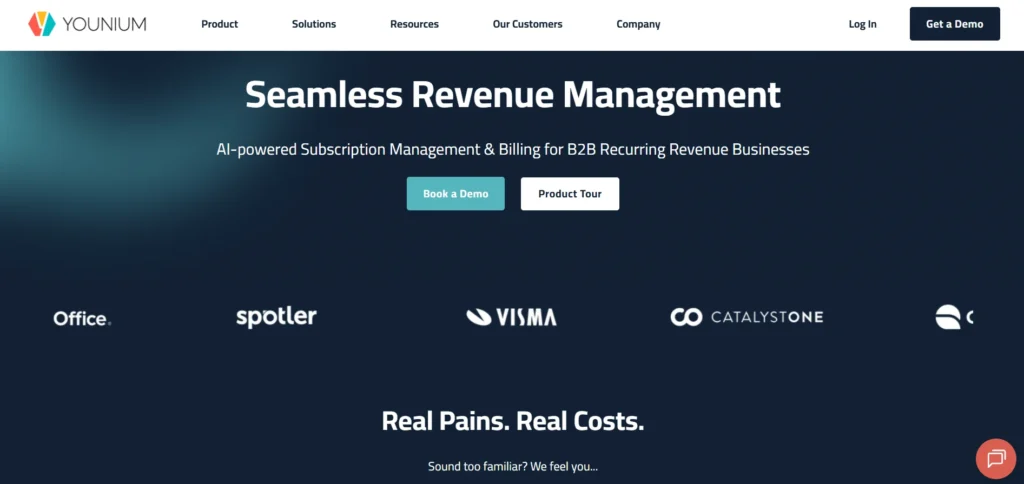
Younium is a subscription billing and revenue management platform designed for B2B SaaS companies that operate with complex contracts, ramp pricing, and hybrid billing models. The platform connects sales, billing, and finance into a single quote-to-cash workflow, ensuring that contracts signed by sales teams are automatically translated into accurate billing schedules, invoices, and revenue plans. It supports recurring subscriptions, usage-based charges, one-time fees, and multi-year agreements, making it suitable for fast-growing SaaS businesses with evolving pricing strategies.
This SaaS Billing Software also provides built-in revenue recognition that complies with ASC 606 and IFRS 15, helping finance teams stay audit-ready while reducing manual spreadsheet work. Real-time reporting on MRR, ARR, churn, and deferred revenue gives leadership full visibility into financial performance. With integrations into CRM and accounting systems, Younium ensures consistent data flow across the entire revenue lifecycle and enables companies to scale without losing control of billing accuracy.
Key Features:
- End-to-end subscription and contract management
- Automated invoicing and revenue recognition
- Support for usage-based and hybrid pricing
- ASC 606 and IFRS 15 compliance
- CRM and ERP integrations
Pricing: Custom pricing based on business size and complexity
Website: https://www.younium.com/
2. Stripe Billing
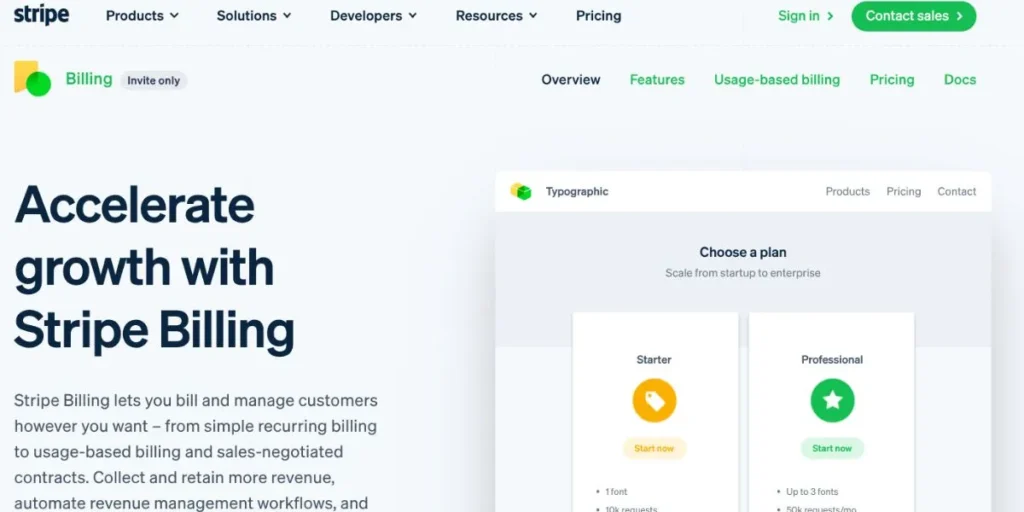
Stripe Billing provides an effective and flexible solution to businesses that need to have recurring payment systems that are deployed quickly with international coverage. The platform is also effective in promoting various pricing models such as metered billing, tiered subscriptions, and per-seat and is also simple to implement.
Businesses are able to use pre-built components to set up quickly, or can use a full-fledged API in the situation of a custom integration that fits their needs. Stripe, a SaaS Software Billing Software, comes with automated invoicing, payment notification systems, and fraud detection functionalities that secure the revenue streams. Dashboard provides live access to sales performance, subscription, and inventory management at each customer touchpoint.
Key Features:
- Multiple pricing models
- Usage metering facilities.
- Global payment support
- No-code configuration
- Automated notifications
Pricing: Usage-based pricing with transaction fees; enterprise pricing by contact.
Website: https://stripe.com/in/billing
3. Zenskar
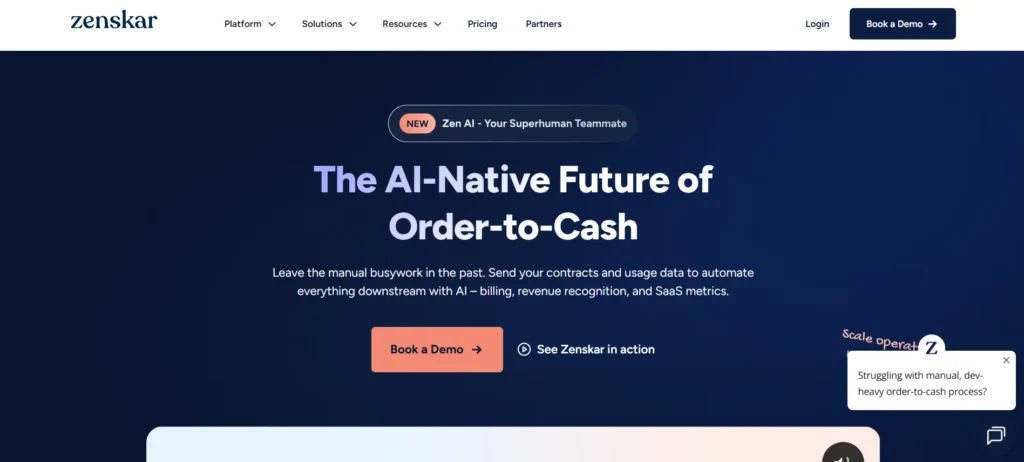
Zenskar is a modern SaaS billing platform designed to handle complex and usage-based pricing models. It helps businesses automate billing workflows, reduce manual effort, and ensure accurate invoicing.
With support for subscription, usage-based, and hybrid pricing, Zenskar offers the flexibility needed by growing SaaS companies. Its integrations and real-time analytics make it easier to manage revenue and gain visibility into business performance.
Key Features:
- Flexible pricing models (subscription, usage-based, hybrid)
- Automated billing and invoicing
- Real-time reporting and analytics
- Integrations with CRM and accounting tools
Pricing: Flexible pricing models (subscription, usage-based, hybrid)
4. Chargebee
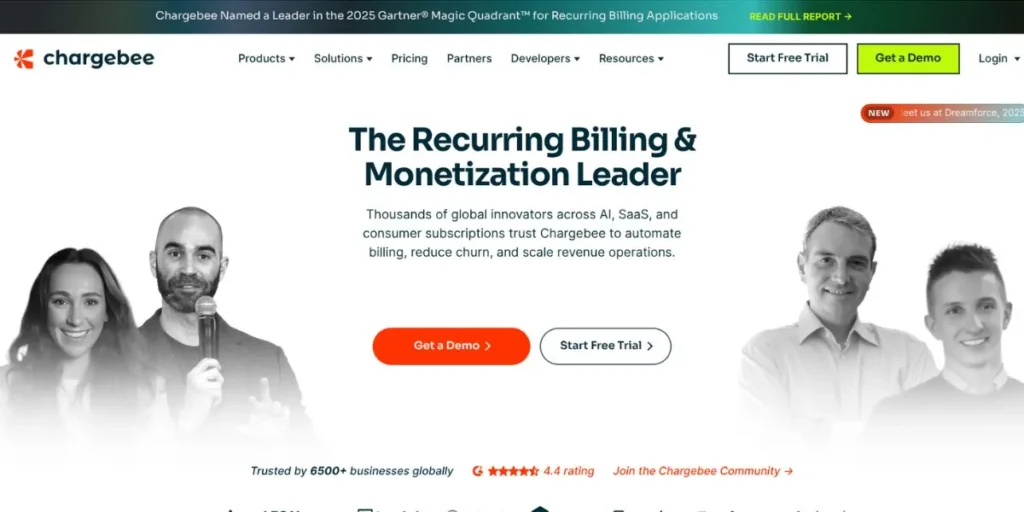
Chargebee focuses on ensuring that companies can make the most of their customer retention and speed up the growth of revenue with the help of intelligent automation and a full range of features. The dunning system based on AI is a major strength of the platform, since it can recover up to eighteen per cent of unsuccessful payments by using strategic timing of the retries in order to optimise the success rate. The SaaS Billing Software systems, such as Chargebee, can support multi-currency transactions with ease and tax compliance across various jurisdictions is automated and does not require any manual intervention.
Advanced analytics services follow key subscription indicators such as monthly recurring revenue, customer acquisition cost and churn predictor variables. The Salesforce and HubSpot integration allows the seamless interoperation of the billing and customer success divisions and establishes a single approach to the problem of customer attrition reduction.
Key Features:
- AI dunning recovery
- Multi-currency transactions
- Automated tax handling
- State-of-the-art analytics dashboard.
- CRM integrations
Pricing: Starter plan that includes a 0.75% fee after 250K revenue; Performance plan that includes 599/month, and a 0.75% transaction fee.
Website: https://www.chargebee.com/
5. Zoho Billing
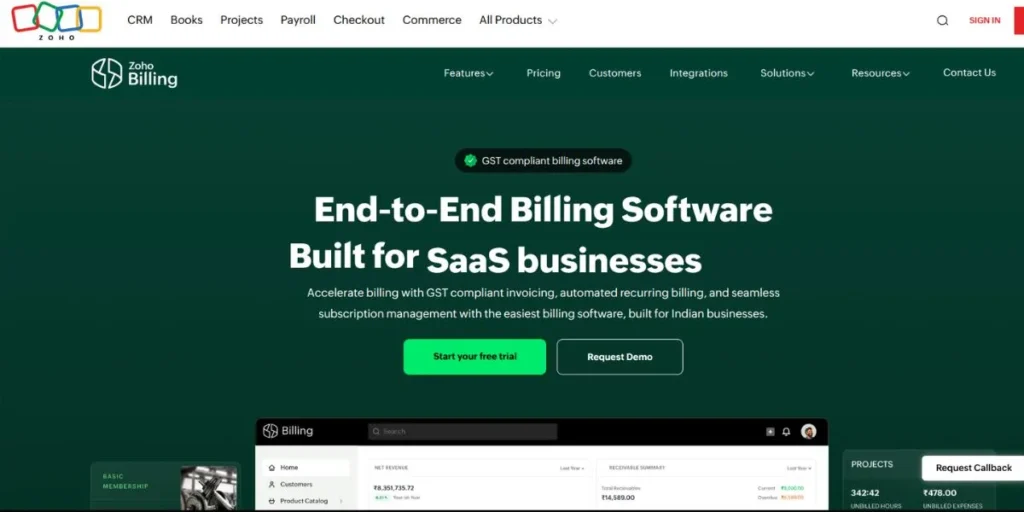
Chargebee focuses on ensuring that companies can make the most of their customer retention and speed up the growth of revenue with the help of intelligent automation and a full range of features. The dunning system based on AI is a major strength of the platform, since it can recover up to eighteen per cent of unsuccessful payments by using strategic timing of the retries in order to optimise the success rate.
The SaaS Billing Software systems, such as Chargebee, can support multi-currency transactions with ease and tax compliance across various jurisdictions is automated and does not require any manual intervention. Advanced analytics services follow key subscription indicators such as monthly recurring revenue, customer acquisition cost and churn predictor variables. The Salesforce and HubSpot integration allows the seamless interoperation of the billing and customer success divisions and establishes a single approach to the problem of customer attrition reduction.
Key Features:
- Various pricing policies.
- Inventory tracking characteristics.
- Linking of payment gateways.
- AI sales assistant
- Automated reminders
Pricing: Free basic plan; paid plans begin at competitive rates, depending on the growing businesses.
Website: https://www.zoho.com/in/billing/
6. Maxio
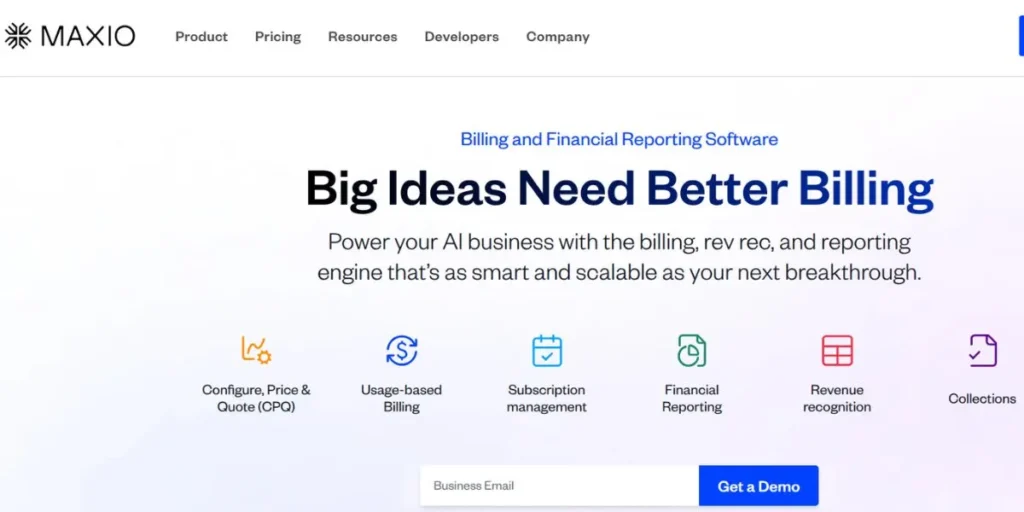
Maxio is focused on business expansion into enterprises that need an advanced control of their finances and revenue management features in their complex business models. The platform is good at serving the hybrid billing models, which integrate subscription fees, usage-based fees, and a single payment per business in the same system architecture. SaaS Billing Software, such as Maxio, makes full conformity to ASC 606 and IFRS 15 standards, and does not make them face the revenue recognition headaches common with growing businesses.
An inbuilt global tax engine takes care of the calculations in over a hundred and twenty countries automatically, which would save the regulatory risks and compliance load to a large extent. Complete integrations with NetSuite, QuickBooks and Xero establish complete automated financial processes that do not have any manual data entry and reconciliation processes.
Key Features:
- Hybrid billing models
- Compliance with revenue recognition.
- Global tax engine
- ERP integrations
- Automated workflows
Pricing: Grow plan, which is $599/month with businesses billing up to 100K/month; bespoke enterprise plans.
Website: https://www.maxio.com/
7. NetSuite
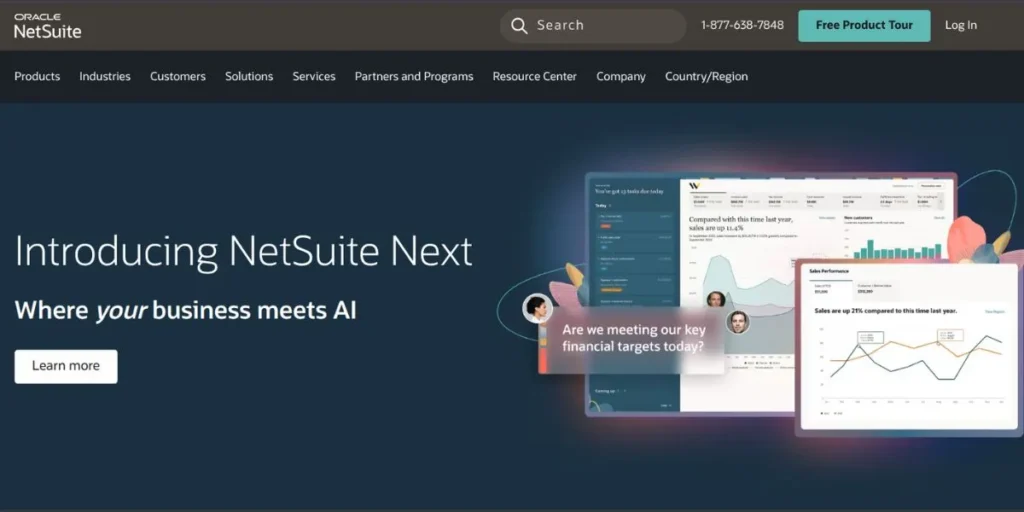
NetSuite by Oracle provides a full-scale cloud-based enterprise resource planning system capable of providing all the functionality of billing, but also includes features of accounting, payroll, and customer relationship management. ERP module offers financial management tools, inventory management tools, order management tools and procurement tools in one integrated system. Many sizes of businesses use NetSuite, and small businesses, especially, have been adopting it with enterprise-level functionality without huge infrastructure purchases.
This SaaS Billing Software allows central pricing management in which organisations are capable of determining and sustaining different strategies in maximising profit margins at the same time being consistent. The AI models, which are developed using the Oracle technology, identify the patterns and produce the predictions based on the established machine learning models on invoice processing, content generation, and detecting financial anomalies.
Key Features:
- Full ERP capability100% centralised pricing management.
- Inventory tracking tools
- Combined payments solution.
- AI-powered analytics
- Pricing: Individual pricing depending on the modules chosen and the size of the company.
Website: https://www.netsuite.com/portal/home.shtml
8. Orb
Orb focuses on niche usage-based billing to API-driven companies processing millions of events every day and having very high accuracy standards. The site processes over ten million usage events daily and offers real-time metering services, tiered pricing frameworks and has full API monetisation features.
SaaS Billing Software, such as Orb, is a solution for companies that charge per API call, volume of data consumed or activity metrics across distributed systems. In-built connections with Snowflake, Big Query, and Looker give finance teams profound analytical information about how the customer uses and consumes these systems. The platform allows proper billing despite the complicated pricing rules and large-volume transaction setup, which is a burden to traditional systems.
Key Features:
- Real-time usage metering
- API monetisation tools
- Tiered pricing structures
- Warehouse consolidations.
- High-volume processing
Pricing: Custom pricing rates that vary with the amount of data and level of billing; prepared to quote on request.
Website: https://www.withorb.com/
9. Stax Bill
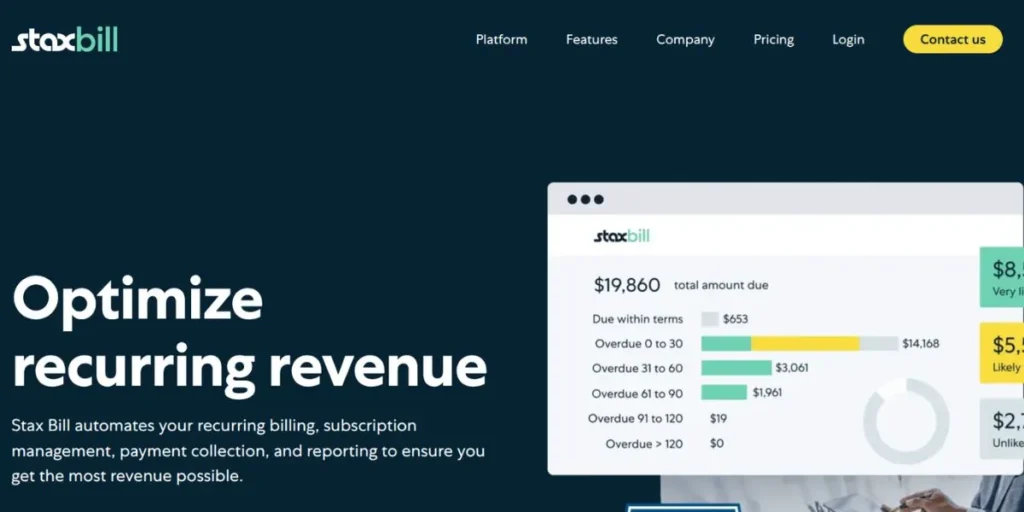
Stax Bill attracts businesses that are interested in having clear, predictable cost systems without having to incur hidden costs or make intricate price calculations as it grows. The platform automates repetitive invoicing activities, tax, and revenue recognition processes and has simple pricing models. It has its own unique features, such as SMS and WhatsApp invoicing notification, which increase the customer engagement rates much higher than in the traditional email-only methods of communication.
SaaS Billing Software, such as Stax Bill, has enabled the capability of real-time tracking of payments and prediction of revenues, which can help businesses in managing the cash flow efficiently and minimising cases of late payments. The flat-rate pricing model will remove any uncertainties and enable finance departments to predict the cost of the software as the revenue increases.
Key Features:
- Flat-rate pricing structure
- SMS invoice notifications
- Real-time payment tracking
- Revenue forecasting tools
- Automated tax calculations
Pricing: Business plan at $499/month for companies with billing no more than $85K per month.
Website: https://staxbill.com/
10. Zenskar
Zenskar gives non-technical teams the power to create, test and roll out innovative pricing models without involving engineering resources or protracted development efforts. The no-code platform provides companies with the opportunity to experiment with discount models, customer rights, and levelled pricing models in real-time systems that replicate the state of production. This SaaS Billing Software is especially helpful to volatile companies that regularly change prices as a way to make the most of the market position and get the most revenue.
An important benefit of this is to make sure that legacy entitlements are preserved in the face of a price change to avoid the revenues disappearing unexpectedly when the grandfathered clientele is deprived of special treatment. The experimentation capabilities bring down go-to-market timelines of new pricing projects to a minimum, as well as reducing implementation threats.
Key Features:
- No-code pricing design
- On-the-fly experimentation system.
- Protection of entitlements of the past.
- Discount management tools
- Quick application of systems.
Pricing: Custom prices according to complexity and enterprise needs; quote requests.
Website: https://www.zenskar.com/
11. Billsby
Billsby represents an affordable option to startups and small businesses that would need the necessary subscription management features without necessarily making investment commitments on par with the enterprise platform. The site provides unlimited subscription packages at reasonable prices and has an easy-to-use interface that allows one to set up and administer the subscription within a few minutes.
Built-in ACH compliance templates save setups considerably since the templates do not require the complex regulatory configuration that generally slows down the setups. Competitive base pricing is still offered, but over time, organisations with a large volume of transactions are likely to ultimately have to switch to enterprise solutions to eliminate scaling-related charges. SaaS Billing Software, such as Billsby, is a rewarding place to begin companies experimenting with subscription models and will not demand substantial investment in more advanced systems.
Key Features:
- The unlimited subscriptions.
- Intuitive interface design
- ACH compliance templates
- Quick setup process
- Affordable pricing tiers
Pricing: Core plan of $45/month and 0.4% of the revenue over $15K; Pro plan of $135/month with 0.5% fee over $30K.
Website: https://www.billsby.com/
12. Salesforce Revenue Cloud
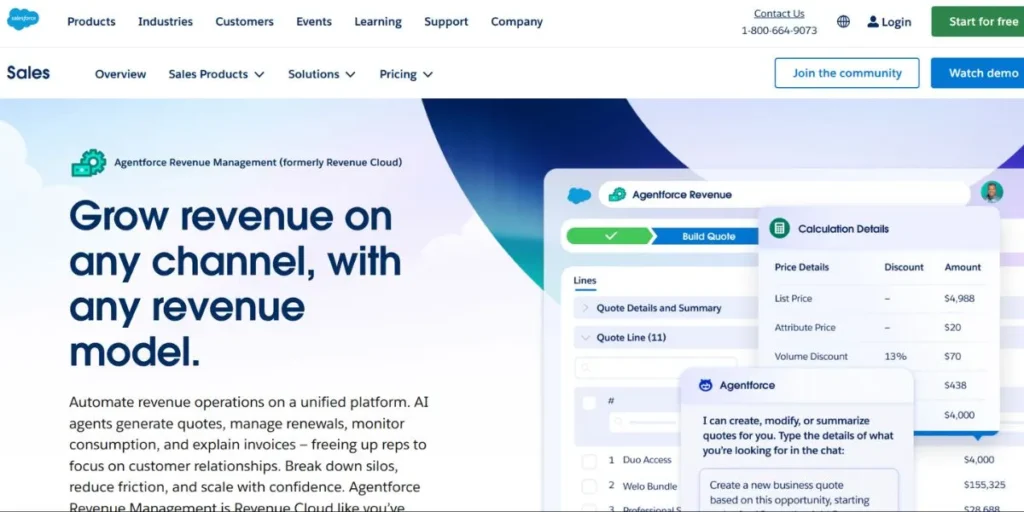
Salesforce Revenue Cloud is an enterprise-level application that combines configure-price-quote capabilities, billing, and subscription services into a multi-functional platform. The Salesforce Customer 360-based SaaS Billing Software is a highly sophisticated system that offers unparalleled insight into the entire revenue life cycle of a quote to final payment collection. The centralised pricing management system provides sales teams with the same pricing across customer touchpoints, and intelligent product features prevent any mistakes in pricing transactions.
The platform records the usage data in detail to be analysed in trends and seamlessly connects with the CRM systems to give a total view of the customer activity. The capabilities of Remitbot using AI will automate the administrative processes, thus making the operations in the finance department more fruitful and lessening the number of man-hours required to interact with the process in any way.
Key Features:
- Centralised pricing rules
- Usage tracking platform
- Multi-channel consolidation
- AI-powered automation
- Real-time workflows
Pricing: Enterprise pricing according to the scope of implementation.
Website: https://www.salesforce.com/sales/revenue-lifecycle-management/
How to Choose the Right SaaS Billing Software
- Business Size Optimisation: Choose platforms with your present size and upgrade options that will accommodate planned growth patterns.
- Pricing Model Support: Make sure that the software will support your particular billing model, such as usage-based, tiered or hybrid.
- Integration Requirement: Check compatibility with existing accounting systems, payment processors, CRM solutions and analytics, which are already implemented.
- Compliance Requirements: Ensuring that the platform can comply with the regulatory requirements that your industry and geographical markets require through automatic means.
- Total Cost Assessment: Estimate total costs of ownership, comprising transaction costs, implementation costs, and possible scaling costs as time progresses.
Conclusion
The choice of the SaaS Billing Software is an essential decision that is going to influence the financial processes, customer satisfaction, and the possibility of the subscription business’s scalability. The reviewed platforms provide a wide array of features, starting with an entry-level solution that can serve a startup and up to an enterprise-level system capable of sustaining complicated international operations.
The adjustment of pricing models, integration needs and compliance needs is carefully analysed to guarantee that the software capability is aligned with the business intentions. The current SaaS Billing Software eliminates manual operations, minimises revenue leakage, and offers actionable insights that can promote strategic decision-making. As a result of investing in the appropriate billing infrastructure, the companies will be in a position to achieve sustainable growth and operational excellence as they continue to grow in their scaling.
Frequently Asked Questions
Purpose of SaaS Billing Software?
Billing Software is an automated recurring billing solution, subscription management, and payment systems and compliance with the requirements of revenue recognition in subscription-based businesses.
What happens to the failed payments in SaaS Billing Software?
Advanced SaaS Billing Software has dunning management systems that enable the automatic retry of failed transactions at the best time, remind payments and update billing modalities to regain revenue.
Does SaaS Billing Software have the ability to be linked with accounting systems?
The majority of SaaS Billing Software solutions have built-in connections with mainstream accounting packages such as QuickBooks, NetSuite and Xero to create automated data integration on financial data.
What price strategies can be used in SaaS Billing Software?
The modern SaaS Billing Software supports subscription-based, usage-based, tiered, and seat-based, hybrid billing, and single-time payments on a single platform.