
Search Engine Positioning SEO is one of the most effective ways to improve your Google rankings and attract consistent organic traffic. Have you ever searched something on Google and noticed that certain websites always appear on the first page—while others stay stuck on page 5 or even page 10? That’s not luck. It’s the result of smart SEO strategies and proper optimization.
In this beginner-friendly guide, you’ll learn how search engines rank pages, why some websites perform better than others, and what practical steps you can take to boost your visibility. From keyword research and on-page optimization to backlinks and tracking tools, this article will explain everything in a simple and easy way. Whether you run a blog, a small business website, or an online store, this guide will help you increase traffic, improve rankings, and build a stronger online presence.
What Is Search Engine Positioning In SEO?
Search engine positioning is the art of ranking particular web pages to be ranked as high as possible on the search engine results pages (SERPs) when particular keywords or queries are typed into the search engine. It concentrates on enhancing on-page aspects such as content relevancy, title tags, meta description, URL structure, and use of keywords, and off-page aspects such as backlinks and domain authority to enhance the rank and visibility of a page.
As compared to the wider scope of SEO that focuses on the general health and structure of a site, search engine positioning has a narrower focus as it is aimed at getting the top positions, particularly within the first few results, since being higher in rank is considered a huge boost in click-through rates, organic traffic, and conversion potential.
Why Search Engine Positioning is Important?
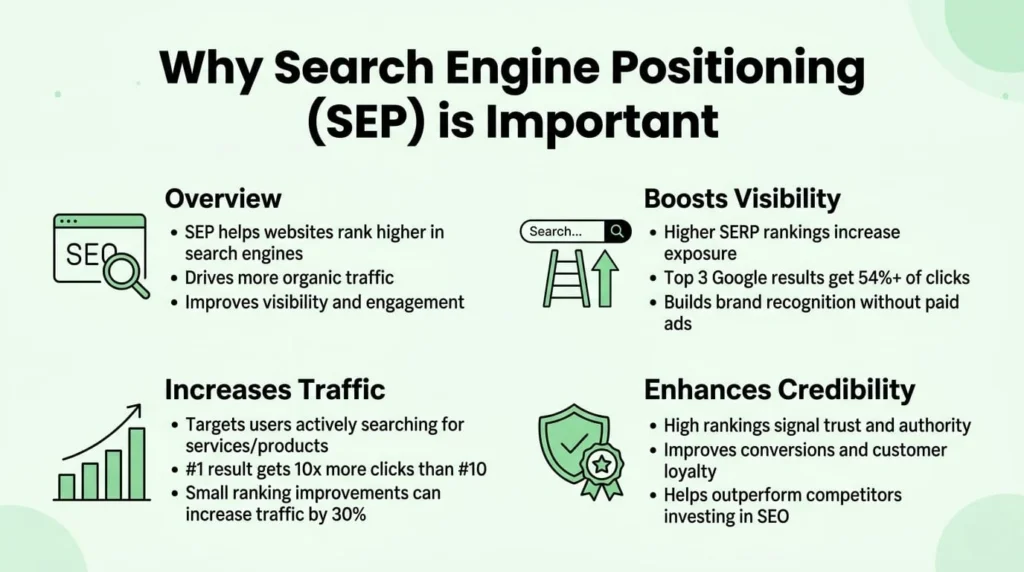
The most important part of SEO is Search Engine Positioning (SEP), which enables websites to be ranked higher in the search results to receive more organic traffic. Businesses are more than pleased because the ranking positions high and attracts clicks and visibility of businesses that rank highly in search engines and are actively engaged in searching.
- Boosts Visibility: Your site will be more visible to prospective customers because of high placements on search engine results pages (SERPs). The first three Google rankings receive more than 54% of clicks, which is much greater than the bottom lines. This exposure creates brand recognition without advertisements.
- IncreasTraffic: SEP optimisation targets users who are now willing to do something and will result in more organic traffic. Research indicates that the first outcome receives 10 times higher clicks in comparison to the 10th, and the CTR decreases significantly after the first page. Even the minor changes in rank can increase traffic by 30 percent.
- Enhances Credibility: High rankings are an indication of reliability to both users and search engines. It makes your brand an authority, increasing conversions and loyalty. These opportunities can be otherwise stolen by competitors who invest in SEP.
How Search Engine Positioning Works?
Search engine positioning works by improving your website pages so they rank higher on Google and other search engines for specific keywords. When a user searches something online, Google scans its index and shows the most relevant and high-quality pages on the first page of results. Google decides rankings based on many factors, including keyword relevance, content quality, page speed, mobile-friendliness, backlinks, and user experience.
If your page answers the search query better than competitors, Google is more likely to push it higher in the search results. To improve positioning, you need to optimize your content with the right keywords, create useful and well-structured pages, build strong backlinks, and regularly update your content. Over time, these efforts help your page move up in rankings and gain more organic traffic.
How Google Evaluates Page Position
- Relevance of the Content: Google verifies whether your page is the one that users require, such as the complete answers to the questions. The extensive coverage of subjects contributes to higher rankings of pages.
- Credibility: Backlinks, brand trust, and E-E-A-T (Expertise, Experience, Authoritativeness, Trustworthiness) create credibility. Verified sites are successful.
- User Experience: Quick loading speed, mobile-friendliness, and convenient navigation are important. Poor UX diminishes rating of good content.
- Indicators of Engagement: Clicks, time, scrolls, and repeat visits are valuable. Pages that are popular ascend.
- Technical Factors: The pages are eligible through crawling using Googlebot, appropriate indexing, and lack of errors. Inthe tent is identified by AI, such as RankBrain, beyond the keywords.
AI-Powered SERPs Role
- AI Summaries: These overall summaries respond to questions directly with Gemini AI, drawing in various sources. They are found in numerous searches, slicing clicks to sites.
- Zero-Click Searches Increase: 83% of AI overview search engines result in no clicks since they provide answers on the page. Maximise on citation rather than rankings.
- Conversational: AI Mode process follow-ups and complicated questions. It divides queries into components to respond better.
- Personalization Increases: Outcomes are based on the history, location, and habits of users. Keyword stuffing is beaten by entity and topic authority.
- SERP Features Develop: People Also Ask, images, and videos are combined with AI. They are most activated by informational queries.
3 Pillars of Search Engine Positioning SEO
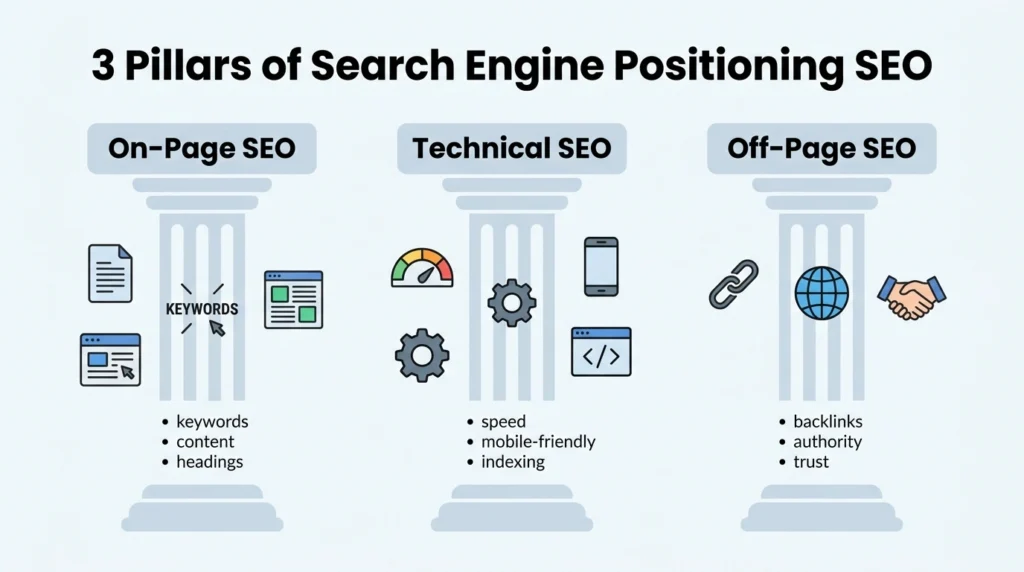
1. Pillar 1 on-Page SEO Optimization.
On-Page SEO optimisation refers to making individual web pages more pertinent and useful to users and search engines by matching content, headings, HTML elements with the target keywords and search intent; optimizing titles, meta descriptions, headings, internal links, images, and body text so that Google can have a clear understanding of what the page is about and can rank it appropriately in search results.
A. Keyword Research and Search Intent.
Keywords research is the act of discovering words and phrases that your audience is actually typing into search engines. Search intent is matching the keywords to what the user desires (informational, commercial, transactional, or navigational), and good SEO begins with selecting keywords that have sufficient search volume and the kind of content that will best respond to that search intent.
B. Semantic SEO and Content Depth.
Content depth entails writing in-depth and exhaustive content that satisfies the query of the user, not merely covering a topic in shallow detail, whereas semantic SEO involves employing related terms, synonyms, and topic clusters in such a way that search engines perceive your page as a logical, expert response to a larger group of queries; it is easier to rank higher with more variations and enhances topical relevance.
C. On-Page Elements Checklist.
A typical on-page elements checklist contains: a well-defined title tag and a keyword, a description meta tag, an H1 with a target topic, the perfect use of H2/H3 subheadings, the optimized image alt text, the internal links to the related pages, the fast-loading content, and the readable and mobile-friendly structure to ensure that the user and the crawler can read and navigate the page easily.
2. Pillar 2 – Technical SEO.
Technical SEO is about the back-end and infrastructure of your site in a way that enables search engines to crawl, index, and render your pages fast. It encompasses site speed, mobile-friendliness, security (HTTPS), clean URL structure, and structured data, and eliminates crawl-blocking problems so that your pages are technically ready to rank.
A. Core Web Vitals (LCP, INP, CLS)
The most important user-experience metrics created by Google are Core Web Vitals: LCP (Largest Contentful Paint) is the speed at which the main page content is loaded, INP (Interaction to Next Paint) is the responsiveness of the page when a user clicks or taps, and CLS (Cumulative Layout Shift) is the stability of the content, ensuring that elements do not shift during page loading.
B. Crawlability and Site Structure.
Crawlability ensures that all your important pages are easily accessed and navigated by search engines through clear navigation, internal linking, and a proper sitemap, whereas a good site structure has a logical hierarchy (e.g., categories → sub-categories → product/posts) such that users and bots understand how pages relate to each other and can prioritize what to index.
3. Pillar 3 - Off-Page SEO and Backlinks.
Off-Page SEO involves practices conducted by other websites to build authority and trust, which are mainly in the form of backlinks, other high quality and relevant websites; this helps your pages to rank higher, although the on-page and technical aspects of your site may be similar to your rivals.
A. Construct Quilty Backlink
Earning links from reputable and topically relevant websites (not spammy link farms) is called building quality backlinks. Each strong backlink works as a vote of confidence and helps transfer authority and trust to your site. Over time, a steady stream of natural editorial links from blogs, news sites, and industry resources can improve your credibility in search. If building backlinks feels difficult, you can also consider using professional link building services to support your SEO growth.
B. Page Authority vs. Domain Authority.
Domain Authority (DA) is the score of the overall trust and strength of a whole website (a scale of 0-100) and Page Authority (PA) is the score of ranking strength of a single page; both are predictive scores produced by SEO tools, and a high-DA web site can transfer more authority to individual pages, but a particular page can still be highly ranked even on a lower-DA web site with excellent backlinks and content.
Best Tools for Search Engine Positioning
Most websites struggle to rank because of simple on-page SEO mistakes. Fixing issues like keyword selection, content quality, technical optimization, internal linking, and content freshness can significantly improve visibility and traffic.
Many beginners also rely only on a few SEO tactics and ignore other off-page strategies like backlinks and submissions. You can also use blog submission sites to create quality backlinks and improve your website authority.
1. Google Search Console.
Google Search Console (GSC) is a free Google tool that demonstrates the appearance of your site in Google Search and what real queries result in impressions and clicks.
- Monitor performance by page and keyword, indexing status, and crawl errors or mobile usability problems.
- You are also able to post new URLs or sitemaps and re-indexing so that your new pages will be displayed sooner in search.
2. Ahrefs / SEMrush
Both Ahrefs and SEMrush are commercial, all-in-one SEO tools utilized in the research of keywords, track the position, and analyze competitors.
- Ahrefs in particular is particularly efficient when it comes to analyzing backlinks and competitor content, with a significant index of backlinks and keywords data that are optimized towards organic-growth-oriented SEO.
- SEMrush has more extensive marketing capabilities (SEO + PPC + social), and is frequently used when you are interested in monitoring a variety of traffic sources and branded-search presence in a single location.
Both aid you in monitoring your standings in the long-term, discovering keyword prospects, and back-engineering what is working better on the top-ranking pages than on yours.
3. Ubersuggest
Ubersuggest began as a free keyword-research add-on, and now it is a full-fledged SEO and content-ideas tool.
- It also assists you with identifying low-competition keywords, content ideas, and competitor page analysis in easy-to-use and more visual dashboards than other enterprise tools.
- It especially works well with beginners and small to mid-size websites that are looking to have an inexpensive alternative to Ahrefs or SEMrush to do simple keyword and on-page SEO.
Common search engine positioning mistakes to avoid
Most of the websites find it hard to rank due to the same on-page SEO errors. By repairing these fundamental problems, which are: the selection of keywords, the quality of content, technical optimisation, internal links and freshness, you can gain a lot of visibility and traffic.
1. Targeting High Competition Keywords
There is a tendency to go after highly competitive or too broad keywords with minimal domain authority , and the result is a waste of time and a low ranking. Rather, target easier to rank long-tail keywords that align with real user intent and are less difficult, as you develop topical authority.
2. Thin content
Slim content-short, shallow, or low-value pages do not meet the needs of searchers and may lead to ranking penalties or even manual penalties. To resolve this, expand passages with real-life examples, data, or step by step instructions and merge or delete duplicate passages or passages less than 300 words.
3. Ignoring On-Page SEO
With no on-page SEO fundamentals (title tags, meta descriptions, headings, URLs, and placement of keywords), it will be difficult to get search engines to comprehend and rank your page. Some basic guidelines such as a brief checklist, optimized H1, a title that is rich in keywords, clear headings, and persuasive meta tags will significantly increase the rates of clicking and ranking.
4. No internal Linking
Lack of internal links isolates pages and undermines your topical structure of your site, which is damaging to indexing and ranking potential. Organise high-traffic pages and connect with newer or deeper content by descriptive anchor text to help users and search engines find and appreciate the content.
5. Not Updating Content
Both search engines and user prefer information that is fresh and up to date; old and outdated information becomes irrelevant and gets surpassed by new and more relevant pages. Periodically review posts that are doing well or worse-than-average, revise statistics, examples, and suggestions, and re-publish messages to indicate that your content is up-to-date and authoritative.
Conclusion
You don’t need to feel intimidated about mastering Search Engine Positioning SEO—it only requires learning a few simple basics. This includes choosing the right keywords, writing useful and in-depth content that answers user questions clearly, improving your website speed and mobile-friendliness, and earning quality backlinks from reputable websites to build credibility. Tools like Google Search Console, Ahrefs, and even free options such as Ubersuggest make it easy to track progress, identify issues like thin content or missing updates, and improve your strategy step by step without being a tech expert.
Whether you’re running a blog, a small business, or an online store, focusing on on-page, technical, and off-page SEO pillars can help your pages climb higher in Google results over the next 3–6 months. With consistency, patience, and regular improvements, you can build free traffic, stronger trust, and a steady online presence in today’s AI-influenced digital world.
Also Read:
- Form submission sites
- PPT submission sites
- Image submission sites
- Social Bookmarking Sites List
- Search Engine Submission Sites
FAQs
Q.1 What Is Search Engine Positioning In SEO?
SEP ka matlab hai specific pages ko specific keywords par Google me higher rank karwana. Ye SEO ka ek part hota hai.
Q.2 How Long Does It Take To Improve Search Engine Positioning?
Usually results 3–6 months me start hotay hain. Competitive keywords ya new website par 6–12 months lag sakte hain.
Q.3 What Is The Difference Between SEO And Search Engine Positioning?
SEO overall website optimization hoti hai (content, technical, backlinks, etc.), jabke SEP specific keywords aur pages ki ranking improve karne par focus karta hai.
Q.4 How do I Check My Search Engine Position?
Aap manually keyword search kar sakte hain ya tools use karein. Best option Google Search Console hai jo average position aur clicks show karta hai.
Q.5 What Tools Are Used For Search Engine Positioning?
Popular tools: SEMrush, Ahrefs, Mangools, AccuRanker, SERanking. Free tools: Seobility, SmallSEOTools, Keyword-Tools.org.