
Did you know you can run a business under a trusted government brand while also serving your community?
Government franchising in India has emerged as one of the most reliable entrepreneurship models in 2026. It offers low-risk, high-impact business opportunities backed by government support, making it ideal for first-time entrepreneurs as well as experienced investors in villages, towns, and Tier-2 cities.
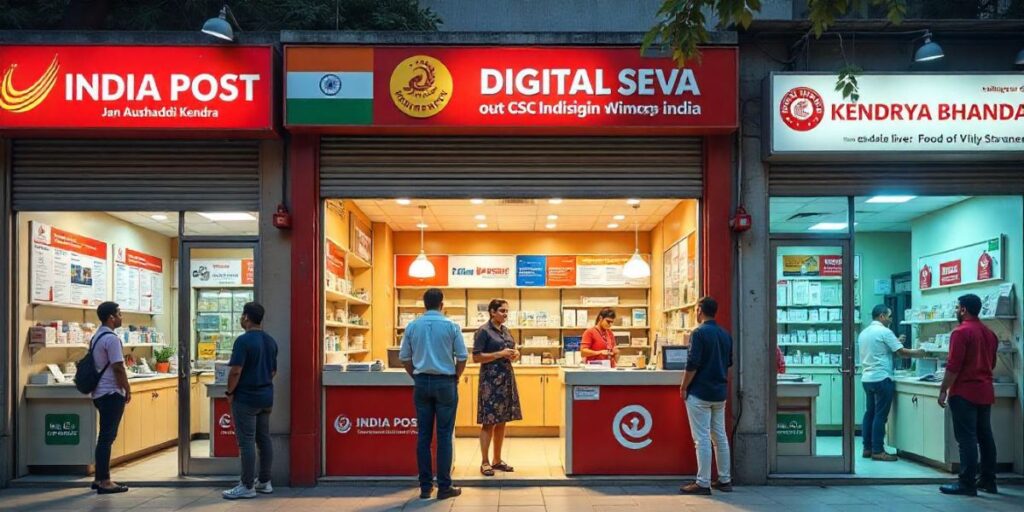
These franchises operate across key sectors such as healthcare, digital services, financial inclusion, postal networks, and agriculture. From Common Service Centres (CSC) and Jan Aushadhi Kendras to India Post franchise outlets, these initiatives have already enabled lakhs of micro-entrepreneurs to build stable incomes while contributing to national development.
Government-backed franchise models are not just about starting a business—they are part of a larger nation-building framework that promotes inclusive growth and strengthens access to essential services, especially in rural and underserved areas.
In this guide, we’ll explore the most promising list of government franchises in India in 2026, including investment requirements, benefits, and how you can get started step by step.
What Are Government Franchises?
Government franchises are business opportunities that are won and approved by the central or state government agencies, government sector undertakings (PSUs) or government-supported schemes. These models are not only aimed at profit, unlike private franchises, but at providing communities that are underserved with much-needed services, such as healthcare, banking, postal services, access to digital services.
The brand name, operational structure, training and in most instances financial subsidies are given by the government to the franchisee. The franchisee in turn acts as a last mile delivery representative of the public services. These franchises are of high trust, constant demand and low risk hence the perfect choice of first time entrepreneurs in India.
Key Highlights of Government Franchises in India
The rapid expansion of government franchises in India is largely driven by increasing public-private collaborations that aim to deliver essential services while supporting economic development. Sectors like postal services, telecommunications, healthcare, and agriculture have seen notable growth through the adoption of franchise models.
Among the most prominent names on the list of Government Franchises in India are India Post and Bharat Petroleum—both of which have played a key role in this transformation.
India Post Franchise operates over 1,00,000 postal outlets across the country, offering services in banking, insurance, and courier delivery, often in partnership with private operators under government regulation. This network has helped bring critical services to even the most remote regions.
Bharat Petroleum Corporation Limited (BPCL) runs more than 17,000 fuel station franchises across India. These outlets generate solid returns for franchisees through the sale of petrol, diesel, and lubricants, making them a highly profitable opportunity under a trusted government brand.
Another major contributor is the Common Services Centers (CSC) program, which has established over 2.6 lakh digital centers providing e-governance, utility payments, and a range of digital public services. These centers are especially impactful in rural and semi-urban areas where digital access is limited.
On the healthcare front, Jan Aushadhi Kendras have revolutionized access to affordable medicine. With over 8,000 stores established, these franchises supply generic drugs at significantly lower prices, reducing the financial burden of healthcare on the common citizen. Their success makes them a critical inclusion in any list of government franchises due to their direct impact on public health and well-being.
Together, these initiatives reflect how government franchises not only support entrepreneurial growth but also contribute toward India’s Sustainable Development Goals (SDGs) by making essential services more affordable and accessible for all.
Benefits of Investing in a Government Franchise
When starting your venture, even simple tools like a business card print.
- A government franchise investment: provides numerous favorable advantages to entrepreneurs:
- Credibility and Trust: Association with a government brand instills greater trust among customers.
- Low Risk: A government franchise presents lower beginning risks than running an individual business from scratch.
- Support & Training: Government franchises offer constant support alongside training equipment to their franchisees.
- Steady Demand: Government services provide fundamental human requirements thus maintaining stable client demand throughout time.
- Financial Assistance: Some government schemes provide financial assistance to franchise development through grants or subsidized loans and financing programs.
Key Sectors Offering Government Franchises
Several sectors offer franchise opportunities under government schemes, including:
- Postal and Courier Services (e.g., India Post Franchise)
- Petroleum and Fuel Distribution (e.g., Bharat Petroleum, Indian Oil)
- Retail and Consumer Goods (e.g., Kendriya Bhandar, Mother Dairy)
- Telecommunications (e.g., BSNL)
- Healthcare and Pharma (e.g., Jan Aushadhi Kendra)
- Agriculture and Fertilizers (e.g., IFFCO Kisan Seva Kendra)
- Banking and Financial Services (e.g., Common Service Centres – CSC)
Government Franchise List with Investment – Quick Overview 2026
| Franchise | Sector | Investment | Profit Potential |
| Common Service Centre (CSC) | Digital Services | ₹50,000 – ₹1.5 lakh | ₹50,000 – ₹2 lakh/month |
| India Post Franchise | Postal Services | ₹5,000 – ₹1 lakh | ₹20,000 – ₹80,000/month |
| Jan Aushadhi Kendra | Healthcare/Pharma | ₹1.5 – ₹2 lakh | ₹30,000 – ₹1.5 lakh/month |
| Bharat Petroleum (BPCL) | Fuel & Energy | ₹15 – ₹70 lakh | ₹5 lakh – ₹30 lakh/month |
| BSNL Retailer Franchise | Telecom | ₹50,000+ | ₹30,000 – ₹1 lakh/month |
| Mother Dairy Franchise | Dairy & Retail | ₹5 – ₹10 lakh | ₹1 lakh – ₹5 lakh/month |
| Kendriya Bhandar | Retail (FMCG) | ₹5 – ₹8 lakh | ₹50,000 – ₹2 lakh/month |
| IFFCO Kisan Seva Kendra | Agriculture | ₹5 – ₹10 lakh | ₹1 lakh – ₹5 lakh/month |
| Sahaj Jan Seva Kendra | Financial Services | ₹1 – ₹2 lakh | ₹25,000 – ₹75,000/month |
| Agri-Clinic (ACABC) | Agriculture/Consultancy | ₹2 – ₹5 lakh | ₹50,000 – ₹1 lakh/month |
| Digital Seva Kendra | Tech & e-Governance | ₹1 – ₹2 lakh | ₹30,000 – ₹1.5 lakh/month |
List of Government Franchises in India: Top 10 Brands 2026
1. India Post Franchise
India Post continues to offer franchise opportunities to individuals and entities aiming to provide postal services in areas where opening a full-fledged post office may not be feasible. The franchise model primarily focuses on counter services, while delivery and transmission services remain under the purview of the Department of Posts.
Investment Required:
- Security Deposit: A refundable security deposit of ₹10,000 is required.
- Setup Costs: The initial investment can range between ₹1 to ₹2 lakhs, depending on factors like location, infrastructure, and services offered.
Revenue & Earnings:
- Registered Letters: ₹3 per article.
- Money Orders (above ₹200): ₹5 per transaction.
- Sale of Postage Stamps & Stationery: 5% commission.
- Speed Post Bookings: Commission ranges from 7% to 25% based on the monthly business volume.
Earnings can vary significantly based on location, footfall, and the range of services offered. While some franchisees might earn between ₹20,000 to ₹25,000 monthly, others in high-demand areas could potentially earn more.
How to Apply:
Visit the official India Post website: www.indiapost.gov.in
Also Read: How to Earn 1000 Rs Per Day Without Investment Online
2. Jan Aushadhi Kendra
The Pradhan Mantri Bhartiya Janaushadhi Pariyojana introduced Jan Aushadhi Kendra franchises in 2008 with the purpose of distributing affordable generic medicines to common people across India. A list of Government Franchises in India would certainly include these centers due to their public health impact.The centers operate with many Benefits of Government Franchises in India. Such that the prices are set between half and nine-tenths lower than branded medication prices to deliver benefits to disadvantaged groups within society.
The medical center program started its operations in 2008 when essential drugs received priority attention for distribution to rural patients and under-served parts of the country.
Investment Required:
A minimum of ₹2.5 to ₹5 lakhs is necessary to set up a Jan Aushadhi Kendra allowing investors to establish the sales outlet while buying medications required to operate the location successfully. The government supports Jan Aushadhi Kendra operators with the provision of assistance which includes both soft loans and subsidies.
Revenue & Earnings:
The operators of generic medicine franchises generate between 15-20% profit on each product they sell via their stores.
The monthly income of franchisees ranges from ₹50,000 to ₹1.5 lakh based on their sales levels.
How to Apply:
To apply, visit the official website: www.janaushadhi.gov.in
3. Bharat Petroleum Fuel Station
As an Indian state-owned company Bharat Petroleum Corporation Ltd. (BPCL) holds the position of one of India’s biggest oil and gas entities and a Low investment government franchise. A list of Government Franchises in India would prominently feature BPCL for its widespread retail presence and accessibility. Fuel station franchises from BPCL permit people to run retail outlets that sell petrol diesel lubricants and various other products under the BPCL brand.
When BPCL launched its franchise program for fuel stations in 1976 the company planned to increase retail operations across India because of expanding fuel requirements.
Investment Required:
BPCL fuel station establishments require investments that start at ₹15 lakhs and reach up to ₹70 lakhs based on the specific location. The funding includes buying land and building infrastructure and purchasing fuel systems and launching business operations with opening capital.
Revenue & Earnings:
The profits depend on how much fuel the sales quantity along with service activities reach while the government controls fuel prices. Franchisees generate profits from petrol and diesel transactions in addition to lubricant sales as well as revenue streams from car washing services and convenience store sales.
Firms operating fuel franchise operations in different areas may earn between ₹5 lakh and ₹30 lakh each month due to several variables including location choice and customer numbers and fuel output volume.
How to Apply:
To apply, visit: www.bharatpetroleum.in
4. Common Service Centres (CSC)
During 2006 the Common Service Centre (CSC) initiative launched its digital services to provide access to both remote and rural regions through the Digital India Program. The Common Service Centres considered by many as the best government franchise in India, offers Franchise business with government support operating as digital service access points for users to conduct e-governance activities including Aadhaar sign-ups and PAN applications as well as bill payments.
CSC started following implementation of the National e-Governance Plan (NeGP) in 2006 until it grafted with the Digital India Mission beginning in 2015.
Investment Required:
To establish a CSC franchise managers need to invest between ₹50,000 to ₹1.5 lakhs that covers the costs of infrastructure including computers and internet access and furniture and operational expenses.
Revenue & Earnings:
Franchisees make their profits through commission-based earnings from services covered by a range of ₹5 to ₹50 generated for each completed transaction.
Payout levels differ from ₹50,000 to ₹2,000,000 within a month because they depend on transaction numbers and government service requirements in the specific territory.
How to Apply:
To apply, visit the official website: register.csc.gov.in
5. Mother Dairy Franchise
One of the Top 10 Government Franchises in India, The Indian community has placed its trust in Mother Dairy since the National Dairy Development Board (NDDB) established this brand back in the 1970s. Through franchising Mother Dairy permits its customers to sell dairy products incorporating milk products plus curd butter and processed food products. Mother Dairy operates extensively in both urban and semi-urban areas by providing premium quality dairy products at reasonable prices.
In 1974 Mother Dairy launched its operations while it began to offer franchising opportunities to spread its retail outlets across India during the early 1990s.
Investment Required:
Initiating Mother Dairy franchise operations demands an initial investment between ₹5 to ₹10 lakhs that covers establishment expenses and purchase of retail equipment and opening stock for the first quarter.
Revenue & Earnings:
The franchisees generate between 10% and 15% in profits for each product sold through the business model. A Mother Dairy franchise generates monthly revenue between ₹3 lakh and ₹5 lakh that depends on location choice and product demand and customer numbers.
How to Apply:
For more details and to apply, visit: www.motherdairy.com
6. Kendriya Bhandar
The Government franchise opportunities maintains Kendriya Bhandar as its retail chain which sells necessary items including food products and housewares. This retail chain belongs to and operates under the Central Government and its main purpose involves serving public employees yet still welcomes non-public customers through its franchised locations. The business operates through two functions by focusing on government employees while providing affordable high-quality merchandise available through its franchise network. making it a notable example of a Zero investment franchise in India.
The government formed Kendriya Bhandar during 1963 under the Ministry of Personnel, Public Grievances and Pensions, Government of India.
Investment Required:
A franchise outlet of Kendriya Bhandar requires investors to invest ₹5 to ₹8 lakhs. Establishing the retail outlet for business and purchasing inventory with all operational costs are among the expenses involved.
Revenue & Earnings:
The earnings from selling products as a franchisee consist of a predictable percentage that varies from 8% to 15% across different items.
The location as well as the sales numbers and customer traffic determine monthly revenue between ₹50,000 to ₹1 lakh at Kendriya Bhandar franchise locations.
How to Apply:
The franchise application process targets the Ministry of Personnel and follows official governmental release announcements. Franchisees who want details about the application process should monitor official notices and use government portals to proceed.
7. BSNL Retailer/Franchisee
BSNL represents a public sector telecom organization that falls under the Top 10 Government Franchises in India. It operates under authority from the Department of Telecommunications of Government India. Through its franchise model BSNL permits people to become storefront dealers who sell SIM cards broadband plans and provide recharge services which helps expand BSNL’s nationwide footprint particularly in rural areas and underdeveloped regions.
BSNL started its retail franchise model in 2000 as part of its expansion effort to reach all areas of India.
Investment Required:
Starting a BSNL retail franchise requires an investment amount starting at ₹50,000 and above. The investment amount for starting a BSNL retail franchise depends on the selected retail design and chosen retail location.
Revenue & Earnings:
The franchisees generate profits mainly through commissions earned from selling SIM cards and broadband connections and recharge services.
Profitability in this venture ranges from ₹30,000 to ₹1 lakh and beyond on a monthly basis based on service volume alongside service offerings.
How to Apply:
To start a BSNL retail franchise you should submit your application at www.bsnl.co.in under the “Retailer/Franchise” page of the official website.
8. Sahaj Jan Seva Kendra
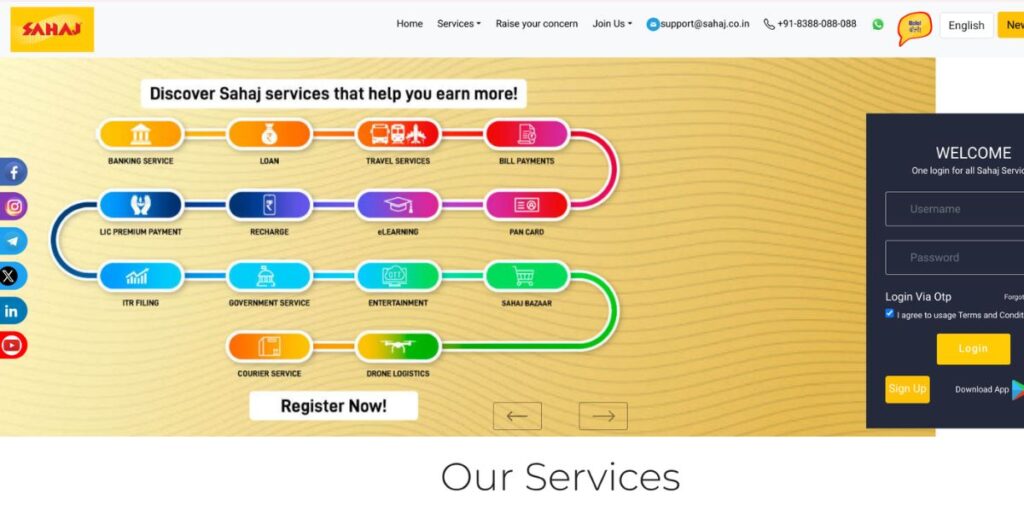
Sahaj Jan Seva Kendra operates as a franchise model delivering insurance services to the public with a range of services from financial to digital payments and pensions and banking solutions. A list of Government Franchises in India would include Sahaj Jan Seva Kendra for its role in expanding financial inclusion. Such Government franchise opportunities are absent from rural and semi-urban communities which the franchise serves. The program functions as a core element to boost access for excluded populations to obtain financial services.
Sahaj Foundation began the initiative in 2015 by focusing on providing e-governance together with financial services into underserved geographic areas.
Investment Required:
The establishment of Sahaj Jan Seva Kendra requires investors to put in a budget between ₹1 lakh to ₹2 lakhs. Building the center and purchasing necessary equipment along with paying the initial service fee total to the investment amount.
Revenue & Earnings:
The franchisees generate their profits through commission payments received from insurance deals and digital payment transactions as well as government service deliveries.
The earnings potential for this franchise business exists between ₹25,000 to ₹75,000 on monthly basis depending on the number of offered services.
How to Apply:
Franchisees can apply by visiting the official Sahaj website: retail.sahaj.co.in.
9. Agri-Clinic and Agribusiness Centres (ACABC)
One of the best Franchise businesses with government support, the NABARD launched ACABC scheme rural stakeholders obtain agricultural consultancy and complete product and service packages at agri-clinics and agribusiness centers. A list of Government Franchises in India would include this initiative for its direct impact on rural agricultural development. The centers operate to serve farmers through crop management recommendations while offering all agricultural inputs starting from seeds and fertilizers and ending with pesticides.
NABARD established the scheme in 2002 to stimulate business prospects in agricultural services and rural farming inputs for entrepreneurs.
Investment Required:
Starting an Agri-Clinic and Agribusiness Center demands an investment amount that ranges from ₹2 lakhs to ₹5 lakhs. The provided funds allow franchisees to construct infrastructure and buy equipment as well as stock agricultural products.
Revenue & Earnings:
The franchisees generate revenue by delivering consultancy services together with agricultural product sales of seeds and fertilizers and pesticides and additional value-added services.
The earnings potential for franchisees ranges between ₹50,000 to ₹1 lakh per month based on the dimensions of their operations and the service area location.
How to Apply:
Applications can be made on the official NABARD website: www.manage.gov.in.
10. IFFCO Kisan Seva Kendra
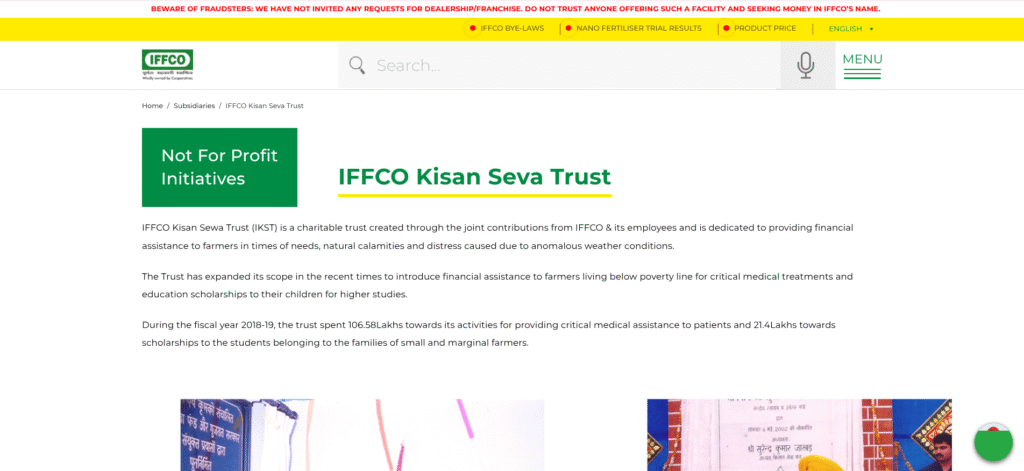
The Indian Farmers Fertiliser Cooperative runs its agricultural service centers under the name IFFCO Kisan Seva Kendras. Through this Low investment government franchise and their centers, a list of Government Franchises in India would include IFFCO provides rural farmers with farm supplies including fertilizers along with seeds and pesticides together with crop management guidance. The service targets rural farmers to provide both products and expert resources that boost their agricultural productivity.
The Kisan Seva Kendra initiative began in 2007 as IFFCO initiated its launch to support farmers in adopting sustainable agricultural techniques and achieving improved access to quality agricultural inputs.
Investment Required:
Establishing an IFFCO Kisan Seva Kendra franchise requires an investment between ₹5 lakhs to ₹10 lakhs yet this amount changes based on franchise size along with location selection.
Revenue & Earnings:
The profitability of franchisees stems from their activities of selling agricultural inputs such as fertilizers and seeds and crop protection products combined with their offering of consultancy services.
The franchise operating income of IFFCO Kisan Seva Kendra differs between ₹1 lakh and ₹5 lakh based on your location and product sales and client network size.
How to Apply:
The official website www.iffco.in holds the application information along with additional details available at IFFCO regional offices.
All franchise operations receive backing from government programs through either direct ownership investments or joint partnership schemes. A list of Government Franchises in India reflects the wide variety of these initiatives. The franchise businesses presented various profit opportunities within retail space alongside telecommunications services and agricultural ventures and financial inclusion initiatives for improved entrepreneurial expansion and better public well-being.
Government Franchise Opportunities by State
West Bengal
- CSC Village Level Entrepreneurs (VLEs): the West Bengal government is strongly encouraging Digital India, particularly in rural districts such as Murshidabad, Birbhum, and Purulia.
- Sahaj Jan Seva Kendra: is located in West Bengal, it has a good network that provides financial and e-governance services to the underserved panchayat areas.
- India Post Franchise: it provides opportunities in the towns and in rural blocks where there are no full post offices in the district.
- BSNL Retailer Franchises: are welcome in the North Bengal districts where the coverage of the telecom privately is still patchy.
- State-supported Mother Dairy booths: and Milk Union franchises (e.g., Banglar Dairy) are aggressively marketed to peri-urban and suburban businesspeople.
Hyderabad
- CSC franchises: well established in the urban agglomeration of Hyderabad-Secunderabad and expanded to the districts of Rangareddy and Medchal-Malkajgiri.
- Jan Aushadhi Kendras: the Telangana government is actively promoting GHMC-limit areas and beyond to mitigate access to generic medicines.
- Bharat Petroleum (BPCL) fuel station franchises: can be found in the outskirts of Hyderabad, especially in the rapidly growing corridors such as Shadnagar and Bibinagar.
- IFFCO Kisan Seva Kendras: are going to the semi-rural areas around Hyderabad, benefiting agrarian communities in Medak and Vikarabad.
- Digital Seva Kendras: supported by the Telangana State government: supplement the central CSC network of e-governance in the gram panchayat level.
Karnataka
- CSC (Common Service Centre): with the state-wide digital empowerment initiative, franchises are proliferating in rural taluks of Karnataka, especially Kalburgi, Raichur and Vijayapura districts.
- Jan Aushadhi Kendras: performing well in lower-income households in Tier-2 cities, such as Mysuru, Hubli and Mangaluru.
- India Post Franchise: the company is targeting hill districts such as Kodagu and Chikkamagaluru where the connectivity is low.
- Mother Dairy and KMF (Nandini) franchises: are well spread in Bengaluru and nearby districts with the assistance of Karnataka Milk Federation.
- BSNL Retailer Franchises: are needed in the northern Karnataka and border districts where 4G private coverage is yet to be fully established.
Which Is the Most Profitable Franchise in India?
The Common Service Centre (CSC) is the most lucrative of all the government franchise opportunities in 2026 in India. With a modest investment of ₹50,000–₹1.5 lakh, a CSC operator can earn ₹50,000–₹2 lakh or more per month by offering over 300+ government and private services — from Aadhaar enrollment and PAN card applications to insurance, banking, and e-learning.
Its commission based structure guarantees the earnings follow the volume of transactions. CSC franchisees seem to record high returns every month in high-footfall locations, particularly in Tier-2 and Tier-3 cities, and related to this, it is the most suitable choice that potential entrepreneurs should consider.
Is There Any Free Franchise in India?
Yes, there are a number of government-supported franchises in India, which need no or very little initial investment:
- CSC (Common Service Centre): There is no franchise fee, and the only expenses are equipment such as a computer and connection to the internet.
- India Post Franchise: Requires only a refundable security deposit of ₹10,000; no heavy capital needed.
- BSNL Retailer Franchise: Can be started with as low as ₹50,000; no franchise fee charged by BSNL.
- Pradhan Mantri Jan Aushadhi Kendra: Government offers one time grant of 2 lakh rupees to the applicants, who are SC/ST and women, and which is virtually free.
- Digital Seva Kendra: Low establishment fee; in many cases, state government subsidies.
- Sahaj Jan Seva Kendra: Low entry barrier with subsidized funds in some states.
Factors to Consider Before Investing in a Government Franchise
- Initial Investment vs ROI – Evaluate your budget and expected earnings.
- Location and Market Demand – Choose areas with higher service demand.
- Franchise Agreement – Study the franchise agreement to understand and determine its contractual terms and its length and exit conditions.
- Support Provided – The franchise provides support in the form of training opportunities along with infrastructure, software and marketing services.
- Compliance & Licensing – Ensure all legal and regulatory approvals.
- Reputation and Performance of the Scheme – Check online reviews and franchisee feedback.
How to Apply for the Government Franchise 2026
- Step 1- Find the Right Franchise: Select a franchise that fits your budget, location, and area of interest (healthcare, digital, postal, fuel, agriculture, etc.).
- Step 2 – Go to the Official Website: Visit the official portal of the scheme (e.g., register.csc.gov.in in the case of CSC, janaushadhi.gov.in in the case of Jan Aushadhi) – do not use intermediaries and agents.
- Step 3 – Review Eligibility Requirements: Review minimum age, educational requirements, land/ infrastructure requirements and financial requirements of the chosen franchise.
- Step 4 – “Ready Your Documents: The most common documents used are Aadhaar card, PAN card, address proof, passport-size photos, educational certificates and a bank account statement.
- Step 5 – Fill Online Application Form: Fill the application form on the official portal. In certain schemes (e.g., Jan Aushadhi), an elaborate business plan might be necessary.
- Step 6 Pay Security Deposit/Registration Fee: Certain franchises (such as India Post) have a security deposit that can be refunded; others are free to register altogether.
- Step 7 – Infrastructure Inspection: A government official/ nodal agency can also visit your premises to ensure that it is up to the expected standard.
- Step 8 – Attend Training and Onboarding: Undergo the compulsory induction and functioning training programme by the government or franchise authority.
- Step 9 – Approval and Begin Operations: Once you have been properly verified and trained you will be given your franchise ID, kit or license to begin operations.
- Step 10 – Provide Continuous Support: The majority of government franchises have helpline numbers, online dashboards, and regular updates on training – take advantage of them to maximise your profits.
Conclusion
The Indian market for Profitable government franchises offers dependable business opportunities to individuals who want to establish ventures with social benefits. A list of Government Franchises in India showcases options that optimize lower risks because they derive support from trusted government institutions together with established operating processes and recognizable brand identity. Such business opportunities extend across healthcare and digital services and retail and agriculture sectors as well as other fields that adjust to national development objectives and digital inclusion targets.
Every business depends on research combined with effective planning and a thorough understanding of investment needs and operational responsibilities to achieve success. Those seeking franchise opportunities must examine local market demand along with examining every clause in their franchise agreement and fulfilling all required regulations. When equipped with appropriate preparation and dedication, government franchises deliver both long-term financial security and the chance to enhance community growth.
FAQs
Are government franchises profitable?
Numerous franchise opportunities offer steady income and rely on essential services that result in consistent customer visits.
Is there a need to run a government franchise that requires prior industry experience?
Not necessarily. All franchises provide education on operations, as well as administrative support.
What is the difference between CSC and Sahaj Kendra?
Two online governance systems provide comparable services yet implement their operations through separate frameworks along with different partner organizations.
Can I run multiple government franchises?
Approval, together with adequate operational management skills, are required to run more than one center.
Do I need to own land to apply for fuel station franchises?
The majority of fuel dealership companies need land ownership from applicants or extended leases for their sites.